
Chris Corcoran’s dad gave him a piece of advice that became the operating philosophy behind two decades of building memoryBlue into one of the most recognized outsourced SDR firms in B2B:
“Don’t blame the barber for a bad haircut. The barber’s doing exactly what you tell him to do.”
That line should be tattooed on the inside of every founder’s eyelids before they make their next marketing decision.
Because here’s what most B2B services founders get wrong about the in-house marketing vs. agency debate: they treat it as a cost question. Or a control question. Or a “what will my board think” question. It’s none of those. It’s a leadership question. And whether you hire an agency or build in-house matters far less than how involved you’re willing to stay either way.
The Decision Founders Think They’re Making
Walk into any founder’s office where this decision is being weighed, and you’ll hear the same conversation. Should we hire someone? Should we extend the agency contract? Should we bring it all in-house now that we’ve hit a certain revenue threshold?
The framing is almost always structural — as if there’s a right org chart that, once drawn, makes the marketing function work.
We sit across from B2B services founders at this exact inflection point almost every week, and the pattern is consistent: the founders who get this wrong aren’t picking the wrong option. They’re treating it as a one-time decision instead of an ongoing commitment.
The agency doesn’t fail because it’s an agency. The in-house hire doesn’t underperform because they’re in-house. Both fail for the same reason: the founder checked out.

Why the Structure Matters Less Than You Think
Chris was blunt about this on our podcast. The most talented people he ever worked with “wanted to work with me all the time… they were always outside my office, knocking on my door, wanting to get me involved.”
That’s not a story about agencies. That’s a story about how strategic work actually gets done in a services business. Whether the person doing the work sits at a desk down the hall or in another city, they need access to the founder’s brain. They need pattern recognition from sales calls. They need to know which clients are the best fits and which ones to stop chasing. They need to understand why your differentiator is real and not marketing fluff.
None of that lives in a Notion doc. It lives in your head. And no model — agency, in-house, or hybrid — extracts it without your active participation.
Junior in-house hires mirror your strategic gaps
Chris is candid that one of his best marketing investments was hiring an exceptional individual straight out of undergrad. She delivered fast. The problem? She wanted to work for a “marketing superstar,” and Chris, by his own admission, wasn’t one.
That’s the hidden cost of the junior hire path. A talented junior marketer will absorb whatever strategic direction you give them and execute it well. They’ll also, very quickly, notice the absence of that direction. If you’re a generalist founder running a services business, you can’t be the CMO they need you to be. You’ll either lose them, frustrate them into mediocrity, or watch them flounder while you wonder why marketing isn’t working. This is one of the most common B2B marketing challenges we see at the early growth stage.

Agencies fail the same way, just with a different invoice
The mirror version happens with agencies. Founder hires the agency expecting to get marketing off their plate. Agency runs onboarding. First month produces some output. Founder skips the strategy call. Then another. By month four, the work is generic because the input has been generic. The founder concludes the agency isn’t any good and starts shopping again.
The barber didn’t give a bad haircut. They gave the only haircut they could give based on the instructions.
The Economics Founders Actually Need to Run
Here’s the cleanest way to think about the math in the early stages:
| Model | Monthly Cost (approx.) | What You Get | What You Need to Provide |
|---|---|---|---|
| Junior in-house hire | $6K–8K | One generalist, full-time, looking to you for strategy | The strategy they don’t have yet |
| Mid-level in-house hire | $10K–14K | One specialist, full-time, in one or two channels | Direction in the channels they don’t own |
| Agency partnership | $6K–15K | A fraction of a senior strategist plus an execution team | Active management and tight feedback loops |
| Senior in-house hire (Director/VP) | $15K–22K | Full strategic ownership | Trust, budget, and time to ramp |
(Cost ranges are directional estimates based on typical B2B services markets; actual figures vary by geography and scope.)
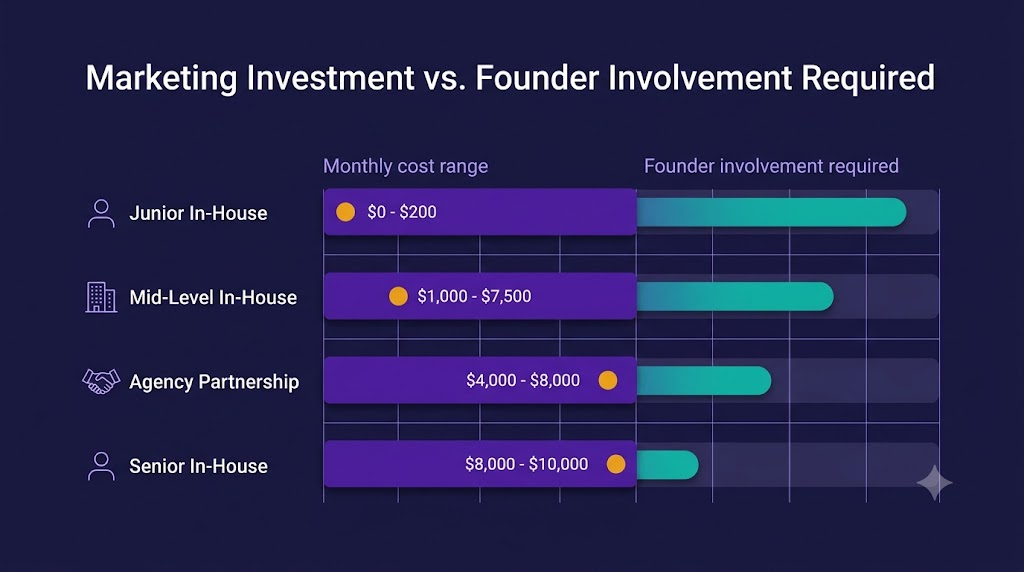
As Chris put it: “With an agency, you’re getting an expert, but you only have to pay for a fraction of the cost… Versus if you hire someone junior, they’re gonna be looking at you to come up with the strategy, and we needed help with the strategy.”
For most founder-led B2B services companies between 10 and 50 employees, the agency-first path tends to win on economics alone — but only if you stay involved. (If you’re going that route, here’s how to pick the right B2B marketing agency for your stage.)
What “Staying Involved” Actually Means
This is where most posts on the topic get vague. So let’s be specific. Staying involved doesn’t mean micromanaging copy or weighing in on font choices. It means showing up for the inputs only you can provide:

- One hour per week, minimum, on strategy — not status updates. What’s working, what isn’t, what we’re changing.
- Sales context that doesn’t live in the CRM. Which deals are stalling. What objections keep coming up. What language your best clients use when they describe what you do.
- Real decisions on positioning. If your team or agency proposes a sharper way to describe what you do, engage with it. Don’t punt it to “we’ll come back to that.”
- Feedback loops with teeth. When something isn’t working, say so early. When something is working, double down fast.
That’s it. It’s not 20 hours a week. It’s the right four to six hours a month, consistently, with the people doing the work. If you want a deeper playbook on this, we’ve written before about how to actually work with a marketing agency so the relationship produces results.

What This Looks Like in Practice
If you’re at the decision point right now, here’s the practical playbook drawn from Chris’s experience and what we see across the B2B services companies we work with:
- Under $5M in revenue and growing through word-of-mouth: Start with an agency. Block one hour a week minimum for strategy review. Treat them like a direct report.
- $5M–$15M with an agency that isn’t working: Audit your own involvement before you fire them. Nine times out of ten, the haircut reflects the instructions.
- $15M+ and ready for an in-house leader: Hire a director-level marketer who can own strategy, and keep an agency or fractional specialists for execution muscle. Don’t ask one junior person to do both.
- In every scenario: Get specific about differentiation. If your answer to “what makes you different” could be claimed by any competitor with a straight face, no marketing model will save you.
The Real Takeaway
Looking back at 24 years of building memoryBlue, Chris’s one piece of advice to his year-one self wasn’t about picking the right agency or hiring the right marketer. It was simpler and harder: start earlier and invest more.
The in-house vs. agency decision isn’t the variable that determines whether your marketing works. Your involvement is. The model is just the vehicle. You’re still the one driving.
If you’re stuck at this decision point — weighing your first marketing hire, deciding whether to renew an agency relationship, or trying to figure out why your current setup isn’t producing pipeline — that’s exactly the conversation we have with B2B services founders every week. Let’s talk through it. We’ll help you figure out the right next move, and just as importantly, the level of involvement it’s going to require from you to make it work.