
B2B content marketing isn’t the same job as general content marketing, even though the deliverables look similar on paper: blog posts, guides, case studies. The difference is who’s reading them and how long it takes them to buy. A B2B buyer researching a five- or six-figure purchase reads differently than a consumer scrolling for a recipe: longer sales cycles, multiple stakeholders, and a real willingness to read something technical if it actually answers the question. An agency that writes well but doesn’t understand that buying process will produce content that reads fine and moves nothing.
That’s also why a bare “top content marketing agencies” ranking isn’t that useful on its own. Most of what ranks for this term is exactly that: a list, sorted by criteria nobody states. Below is a 12-point methodology first, so you can judge these eleven agencies (and any agency pitching you next) against something more specific than “good reviews,” followed by a comparison organized by what each agency actually specializes in, not a single flat rank.
Here’s what’s in this post:
- The 12-point methodology we use to evaluate content marketing agencies, plus a red-flags checklist for proposals
- Eleven agencies, bucketed by what they actually specialize in, not ranked top to bottom
- A quick way to match your situation to the right kind of partner
- Straight answers on budget, timelines, and how to read a case study
How to evaluate a content marketing agency
For a content agency specifically, this matters more than it does for most other marketing disciplines: the content itself, its quality, its accuracy, whether it actually ranks or converts, is the deliverable. There’s no campaign dashboard to hide behind. Either the writing is good and it works, or it isn’t and it doesn’t. That makes proof of work (point 8 below) especially central here.
- Team model transparency. Can you name who’s actually writing and editing your content, strategist, writer, editor, designer, or is it an opaque “account manager plus subcontractors” you’ll never meet? Ask for names and roles before you sign anything.
- Accountability structure. What is the agency actually on the hook for? There’s a ladder here: delivery only (posts shipped), leading indicators (traffic, rankings, conversion rate), or the full plan and its measurement. Most agencies stay vague about which rung they’re on.
- The lead or pipeline guarantee question. Treat this as a red-flag detector, not reassurance. Any agency promising a specific number of leads or pipeline dollars from content before doing diagnostic work on your business is either overpromising or guessing. The credible answer is a forecast built from your own historical and competitive data, reported against every month.
- Specialization fit, not just size fit. “We’ve written for some tech clients” is a different claim from “most of our book is B2B tech.” Content that works for B2B technical buyers, developers, IT leaders, technical founders, reads differently than content written for a general SMB audience. Ask what percentage of their client roster is B2B tech.
- Strategy-execution model. Some agencies are strategic consultancies that hand you a content plan and leave the writing to you. Some are execution vendors waiting on a strategy you don’t have. Fewer do genuinely both under one roof.
- Pricing model transparency. Can the agency explain, in one or two plain sentences, how a scope change, more posts, a new content format, moves the price? “It depends” with no follow-up is a signal.
- Visibility into work in progress. Is there a real-time portal or dashboard showing what’s in the writing queue, in edit, published, or do you find out what happened in a monthly status deck two weeks later?
- Proof of work, adjusted for reality. This is the one to weigh most heavily for a content agency. Named case studies with hard numbers aren’t always possible, plenty of good agencies can’t publish client names or results due to confidentiality agreements, and that’s normal, not disqualifying. What matters is whether they can show you real work samples, actual published articles, actual client sites, even without attributable results attached. An agency with zero visible proof of anything they’ve written is the actual problem.
- Ramp and contract flexibility. What’s the minimum commitment? What does month one actually look like: keyword research and topic strategy, or posts already publishing? A defined ramp is a good sign; “we’ll figure it out” is not.
- Who actually touches the account. Is a senior strategist or editor involved throughout, or does your account get handed to a rotating freelance pool after the contract is signed?
- Tech stack transparency and cost bundling. What does the agency actually run on for research, SEO, and reporting, their own tools, your existing stack, or a mix, and is that cost bundled into the retainer or billed separately? Ask for the specific tools before you sign, not after a separate bill shows up.
- Baseline and benchmarking methodology. How does the agency establish a starting baseline, traffic, rankings, engagement, before the first post goes live? An agency with no stated baseline methodology can’t credibly show improvement later, because there’s nothing real to measure against.
Red flags in a proposal, worth naming explicitly:
- Deliverables described only in outcomes (“more leads,” “brand awareness”) with no itemized scope behind them
- A specific lead or pipeline number promised before any diagnostic work has happened
- No named individuals on the account, just a generic “team”
- Case studies with no stated methodology, how the result was tracked, over what period, attributed how
- A boilerplate proposal that doesn’t reference anything specific about your business
- No visibility mechanism offered until you ask for one
We evaluated the eleven options below against these twelve criteria, on top of the baseline you’d expect from any credible content agency: real B2B tech writing experience and a repeatable process, not a one-off freelancer relationship.
The eleven agencies, organized by what they actually do
Here’s the full list before the breakdown:
- New North
- Grow and Convert
- Omniscient Digital
- Siege Media
- Animalz
- Optimist
- First Page Sage
- Brafton
- Codeless
- Column Five (now branded as Five)
- Verblio
Note: These are grouped by specialization, not ranked. An agency further down a list isn’t a worse option, it’s a different fit for a different situation.
New North
At a Glance
- Program: Authority (thought leadership, organic content, and search-driven visibility, built to make you the company your market trusts before they’re ready to buy)
- Notable clients: Aquatic Informatics, Ricoh Global Software, DocLib, Tyfone, FoxyAI
- Pricing: Execute ($4,000-$5,900/mo, one program), Perform ($6,000-$11,900/mo, two programs), Grow ($12,000+/mo, all three programs)
We’re listing ourselves first because this is our blog.
Content sits inside our Authority program. If what you actually need is paid media and conversion work rather than organic content, that is Reach, and the agencies for it are in our comparison of B2B advertising agencies and demand generation agencies. For the wider category, see our B2B marketing agencies comparison and everything filed under content and authority marketing.
New North runs content as one of three programs, Authority, alongside Reach (paid media and conversion content) and Pursuit (account-based marketing against a named list). Authority is the content-relevant one: organic content and search-driven visibility built by named writers, strategists, and analysts under one account director, not a rotating freelance pool. You’re hiring a marketing team, not booking a task off a menu.
We don’t guarantee traffic, rankings, or pipeline from content, and neither can anyone else running a program like this. What we do instead: build a forecast from your own historical and competitive data, then report against that forecast every month through a client portal where every task is logged and tied to the plan. That forecast doubles as your baseline, so there’s something real to measure improvement against, not an arbitrary target.
Bottom Line
New North works best for mid-market B2B tech companies that want content built by a named team as part of a broader, integrated program, not a standalone freelance relationship, with real visibility into what’s shipping and why.
Bucket 1: SEO and organic-growth specialists
These three build content as an engine for organic search traffic first, with a named methodology behind how they pick topics and measure results.
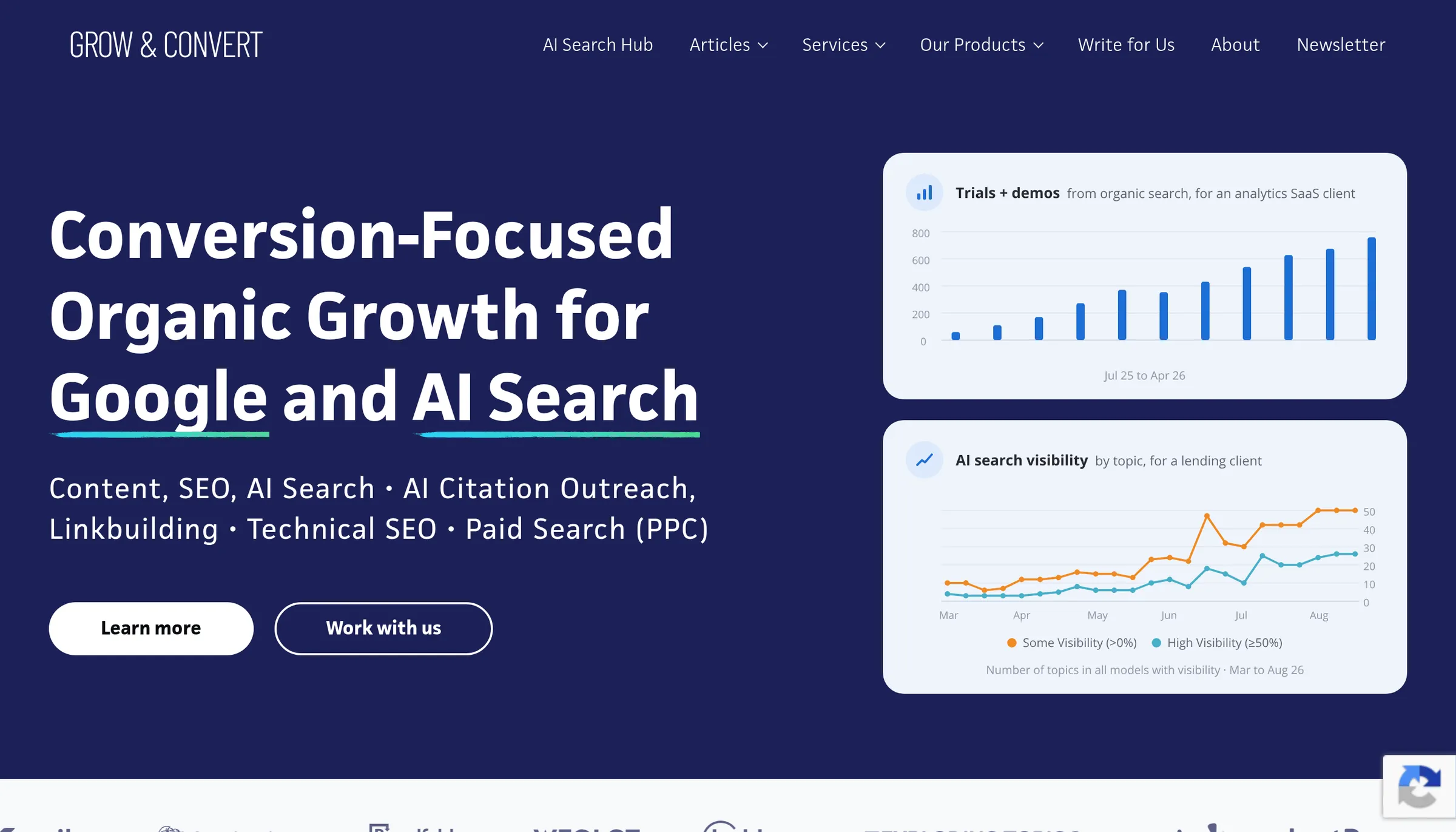
1. Grow and Convert
At a Glance
- Focus: Content, SEO, and GEO (generative engine optimization), built around a named “Pain Point SEO” methodology
- Track record: 10+ years operating, 100+ clients served
- Notable clients: Wrike, ServiceTitan, Yelp, Clearscope
- Proof of work: Rainforest QA case study, #1-3 Google rankings achieved for 25+ high-intent keywords
Grow and Convert built its whole practice around a specific, named methodology, “Pain Point SEO”, which targets keywords tied to a prospect’s actual buying pain rather than generic top-of-funnel search volume. Naming the methodology outright is itself a useful signal under criterion 2: you know exactly what they’re optimizing for before you sign anything.
A decade in business and 100+ clients served is a meaningful data point on specialization fit, and their named client roster, Wrike, ServiceTitan, Yelp, Clearscope, spans recognizable B2B software brands. Their Rainforest QA case study is a clean example of proof of work done right: a named client, a specific result (#1-3 rankings for 25+ high-intent keywords), not a vague “increased visibility” claim.
Bottom Line
Grow and Convert works best for B2B software companies that want content built specifically around pain-point search intent, with a decade of track record behind the methodology.
2. Omniscient Digital
At a Glance
- Focus: Organic growth, SEO, and GEO for B2B software companies
- Notable clients: SAP, Adobe, Asana, HubSpot
- Proof of work: Jasper (810% organic session growth, 400X signup growth, $4M ARR attributed to blog content), Order.co (2117% blog session growth, 39X conversion growth), Smartling ($3.7M in pipeline attributed to organic content)
Omniscient Digital is built specifically around organic growth for B2B software companies, and its published case studies are among the more heavily quantified in this list. The Jasper numbers in particular, 810% organic session growth and $4M in ARR attributed directly to blog content, name both the mechanism (blog content) and the business outcome, which is exactly the kind of methodology-backed proof of work criterion 8 asks you to look for.
Their client relationships include enterprise names like SAP, Adobe, Asana, and HubSpot, alongside the mid-market growth-stage companies (Jasper, Order.co, Smartling) where the most detailed public numbers come from.
Bottom Line
Omniscient Digital works best for B2B software companies that want an organic-growth specialist with some of the most detailed, publicly quantified content case studies in the category.
3. Siege Media
At a Glance
- Focus: GEO, content, and SEO, vertical-agnostic across fintech, e-commerce, health, travel, real estate, and cybersecurity, alongside SaaS
- Notable clients: HubSpot, Zapier, Zendesk, Asana, ServiceNow, Drata
Siege Media is a well-resourced content and SEO agency, but it’s worth being direct about specialization fit here: it isn’t a B2B-tech-exclusive shop the way several others on this list are. Its client base spans fintech, e-commerce, health, travel, real estate, and cybersecurity in addition to SaaS. That’s not a knock, a vertical-agnostic agency often means more institutional SEO and content-production muscle, but it does mean less of its collective experience is specifically B2B technical-buyer content.
That said, its B2B SaaS client list is real and recognizable: HubSpot, Zapier, Zendesk, Asana, ServiceNow, and Drata all appear in its roster, which is meaningful evidence it can operate in this category even if it isn’t the only category it serves.
Bottom Line
Siege Media works best for B2B SaaS companies comfortable hiring a larger, vertical-agnostic content and SEO shop that also happens to carry a strong roster of recognizable SaaS clients.
Bucket 2: B2B SaaS thought-leadership specialists
These two build content specifically for B2B SaaS audiences, with named frameworks for how they approach strategy.
4. Animalz
At a Glance
- Focus: Premier B2B SaaS content and thought-leadership agency, also offering AEO (AI answer-engine optimization)
- Notable clients: Amplitude, WorkOS, Airtable, Intercom, UiPath, Ramp, Segment
- Proof of work: SupportLogic (5x organic traffic growth in 12 months), Unit21 (fraud-fighting educational content, described as generating “$Millions in Pipeline”)
Animalz has built its reputation specifically around B2B SaaS thought leadership, and its client roster reads like a list of well-known enterprise SaaS names: Amplitude, WorkOS, Airtable, Intercom, UiPath, Ramp, Segment. That’s about as concentrated a specialization signal (criterion 4) as you’ll find in this category.
It has also expanded into AEO, AI answer-engine optimization, which is a reasonable evolution for a thought-leadership content shop given how much research now happens inside AI chat tools before a prospect ever visits a website. Its published case studies name real growth numbers: SupportLogic’s 5x organic traffic growth in 12 months, and Unit21’s fraud-fighting educational content generating what it describes as “$Millions in Pipeline,” a figure worth reading as directional rather than a precise number, since it isn’t broken down further in what’s published.
Bottom Line
Animalz works best for enterprise-tier B2B SaaS companies that want thought-leadership content built by a specialist with a genuinely concentrated SaaS client roster, and that also want a path into AEO.
5. Optimist
At a Glance
- Focus: B2B SaaS and tech content specialist, built around a named “CORE Framework” methodology
- Pricing: Published retainers at $3,000-4,000+/mo, plus a $7,500 one-time content roadmap engagement
- Notable clients: Semrush, Superhuman, Sendbird, HelloSign
- Proof of work: Glide (14X lead growth, +1,270% organic traffic), Stampli (5X pipeline growth), Kubera (43X signup growth)
Optimist is explicit about being a B2B SaaS and tech content specialist, not a generalist, and it names its own methodology, the “CORE Framework”, the same way Grow and Convert names Pain Point SEO. That’s a clear answer to criterion 5: you know what strategic process you’re buying before you sign.
It’s also one of the more transparent agencies on this list about pricing (criterion 6), publishing retainer ranges of $3,000-4,000+/mo and a standalone $7,500 content roadmap engagement for companies that want strategy before committing to ongoing execution. Its case studies name real, growth-stage SaaS clients with striking multiples: Glide’s 14X lead growth, Stampli’s 5X pipeline growth, Kubera’s 43X signup growth, alongside recognizable brand names like Semrush, Superhuman, Sendbird, and HelloSign.
Bottom Line
Optimist works best for growth-stage B2B SaaS companies that want a named content methodology, transparent published pricing, and a lower-commitment way to start with a roadmap engagement before a full retainer.
Bucket 3: Full-service and broader-reach content agencies
These four are legitimate, established options, but each comes with an honest fit distinction worth knowing before you talk to them: broader industry reach, a different growth-stage philosophy, or a materially different budget tier than most of this list.
6. First Page Sage
At a Glance
- Focus: 17-year SEO, GEO, and content agency, with dedicated B2B Content Marketing and Demand Generation service lines
- Notable clients: Salesforce, Logitech, Verizon, US Bank
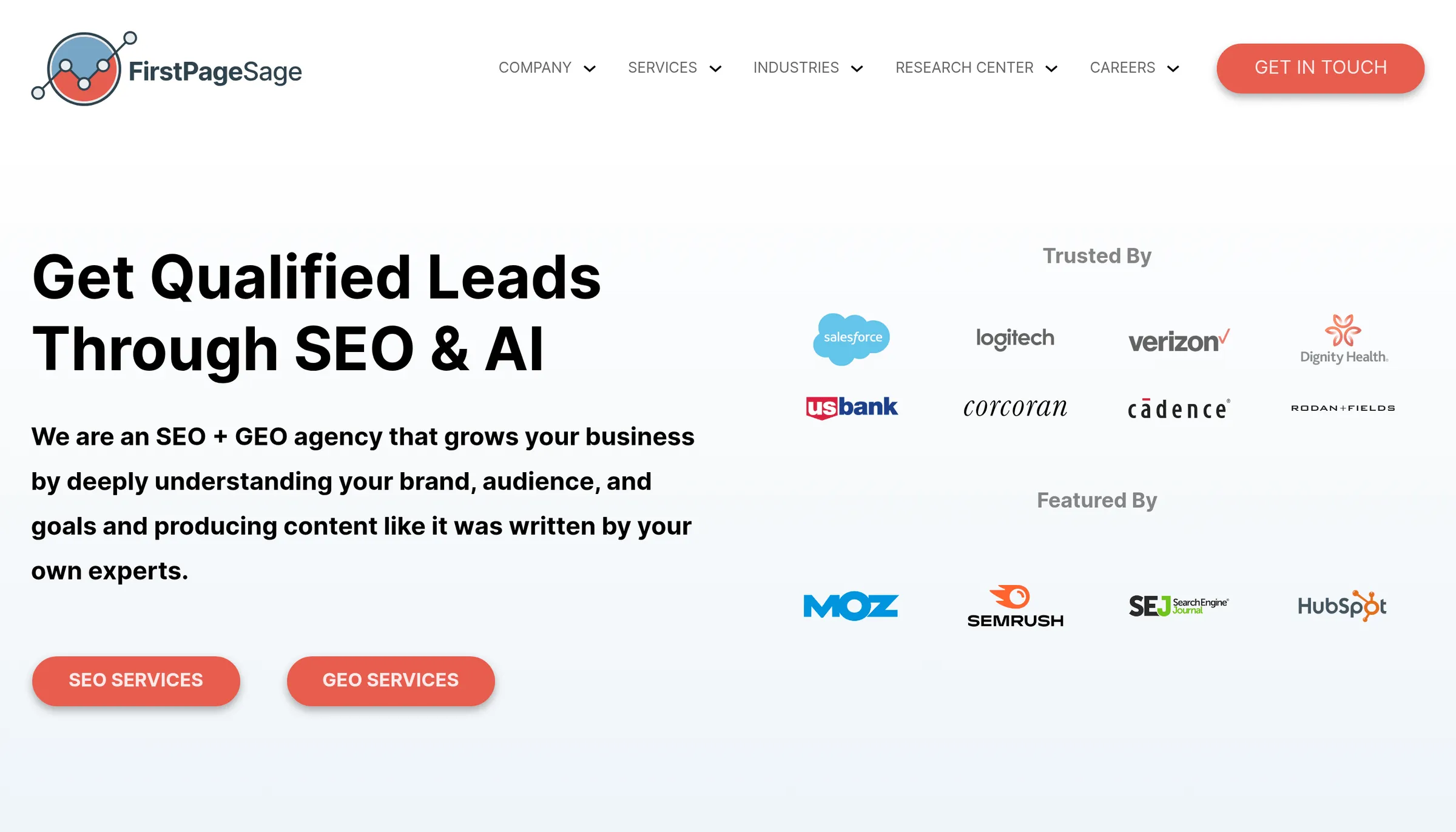
First Page Sage has been operating for 17 years and runs dedicated service pages for both B2B content marketing and demand generation, which is a useful signal if you’re trying to decide whether you need one discipline or both. Worth being direct, though: its named client roster, Salesforce, Logitech, Verizon, US Bank, spans multiple industries well beyond B2B tech. It’s a broad, established SEO and content agency, not a pure B2B-tech specialist the way several others on this list are.
That broader reach can be an asset (more institutional experience across industries and search environments) or a mismatch (less concentrated experience with the specific buying cycles of B2B tech), depending on what you’re optimizing for.
Bottom Line
First Page Sage works best for B2B companies that want an established, 17-year agency with both content and demand-generation service lines, and that are comfortable with an agency whose client base isn’t exclusively B2B tech.
7. Codeless
At a Glance
- Focus: Content, SEO, and conversion infrastructure combined into what it calls “owned growth systems,” built for hypergrowth B2B SaaS companies
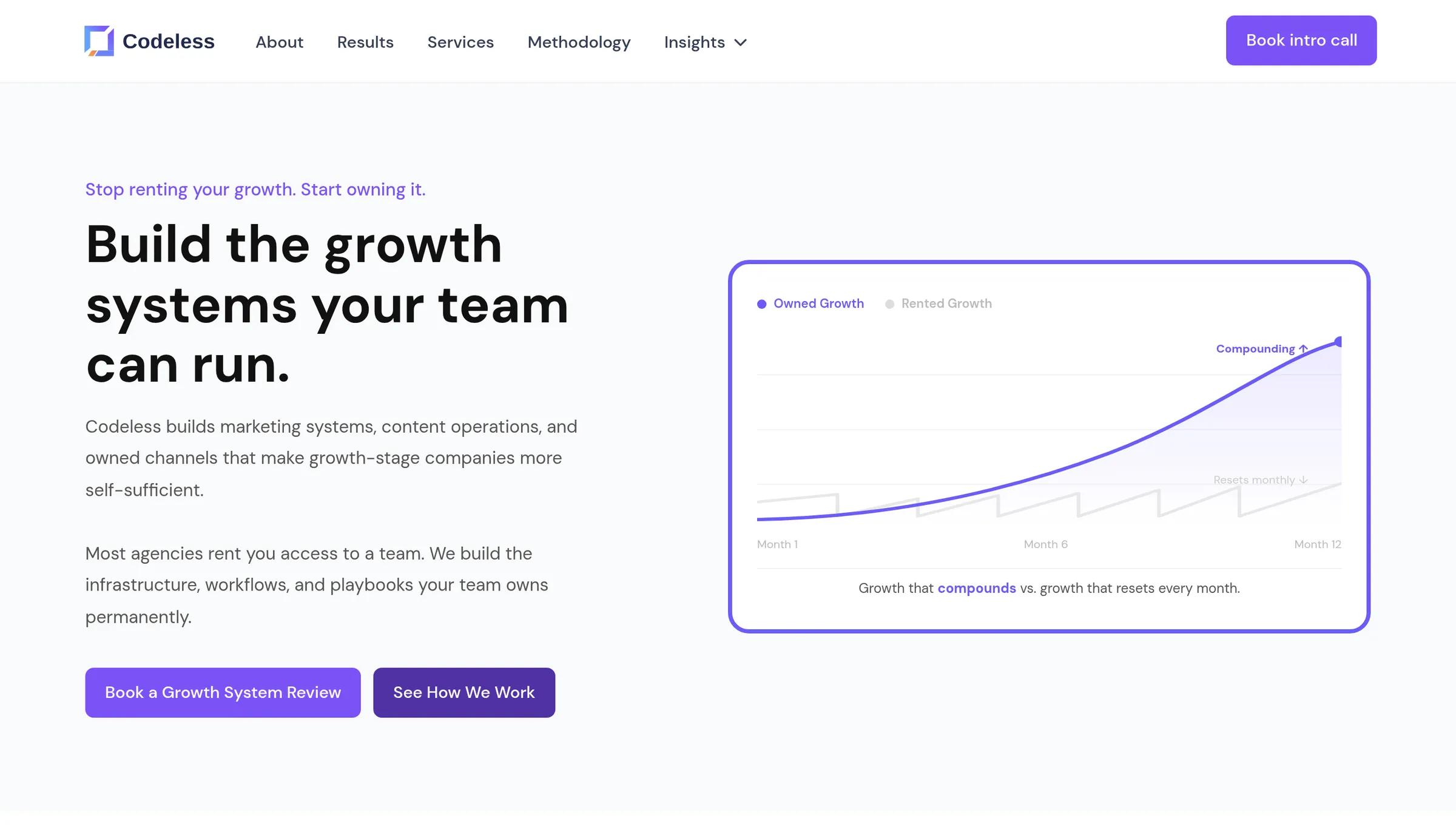
Codeless has repositioned itself around owned growth systems, bundling content, SEO, and conversion infrastructure into one system rather than treating content as a standalone deliverable. Its stated focus is hypergrowth B2B SaaS companies specifically, which is worth naming plainly as a real distinction, not a knock on either approach: a hypergrowth, scale-at-all-costs client profile is a genuinely different fit philosophy than a mid-market company that wants sustainable, controlled growth without over-extending its budget or team. If your board is pushing for growth at any cost, that alignment matters. If it isn’t, it’s worth asking how that shows up in the actual engagement.
Bottom Line
Codeless works best for fast-scaling, hypergrowth-stage B2B SaaS companies specifically, less so for mid-market companies prioritizing sustainable, controlled growth over growth at all costs.
8. Brafton
At a Glance
- Focus: Large, established full-service content marketing agency, self-described as one of the industry’s most established content shops
- Notable clients: Broad enterprise-and-SMB base across many industries
Brafton is a genuinely large, well-established content marketing agency, one of the more recognizable names in the category. Worth being direct about fit, though: its client base spans enterprise and SMB companies across many industries, not a B2B-tech-exclusive roster like several other agencies on this list. That scale can mean more production capacity and process maturity, but less concentrated experience with the specific research habits and buying cycles of technical B2B buyers.
Bottom Line
Brafton works best for companies that want the resources and process maturity of a large, established content agency, and that don’t need a B2B-tech-exclusive specialist.
9. Column Five (Five)
At a Glance
- Focus: Premium/enterprise-scale content, design, and brand-storytelling agency (now rebranded as “Five”)
- Notable clients: Databricks, Vercel, HubSpot
- Pricing: Published engagements from $25,000-$150,000+
Column Five, now operating under the name Five, sits at a genuinely different budget tier than nearly everything else on this list. Its own published pricing runs $25,000-$150,000+ per engagement, which puts it well above New North’s own published tiers and most of the other agencies here. That’s worth stating plainly rather than glossing over: this is a premium, enterprise-scale option built around content, design, and brand storytelling together, not primarily a volume content-production shop, and its named clients, Databricks, Vercel, HubSpot, reflect that positioning.
Bottom Line
Five works best for well-funded B2B tech companies with brand-storytelling and design ambitions that justify a materially higher budget tier than most agencies on this list.
Bucket 4: Content production vendor (a different category)
10. Verblio
At a Glance
- Category: Content-production and freelance-writer marketplace, explicitly positioned as an “affordable alternative to working with an agency”
Verblio deserves its own bucket because it isn’t really the same kind of thing as the ten agencies above. It’s a content-production platform, a marketplace of freelance writers, built to produce ongoing blog and content writing at scale, and it markets itself directly as a lower-cost alternative to hiring an agency at all. That’s a legitimate option for a specific need: high-volume, straightforward blog content without a strategist attached to it.
But it’s a different category than a strategic content marketing agency, and it’s worth knowing the difference before you compare pricing side by side. An agency (like the ten above) typically comes with strategy, editorial oversight, and a named point of contact tied to your specific goals. A production platform gives you writers and volume, without the strategic layer built in. Neither is wrong, they solve different problems.
Bottom Line
Verblio works best for teams that already have a content strategy in place and just need reliable, affordable writing capacity to execute it, not for teams that need an agency to build the strategy in the first place.
Match your situation to the right kind of partner
- Mid-market B2B tech company wanting content built by a named team inside a broader program? New North’s Authority program gives you that, with real visibility into what’s shipping.
- Want a named, pain-point-driven SEO methodology? Grow and Convert.
- Want heavily quantified organic-growth case studies? Omniscient Digital.
- Comfortable with a larger, vertical-agnostic shop that still carries strong SaaS clients? Siege Media.
- Enterprise SaaS company wanting concentrated thought-leadership specialization, plus AEO? Animalz.
- Growth-stage SaaS company wanting a named framework and transparent pricing? Optimist.
- Want an established agency covering both content and demand generation? First Page Sage, with the caveat that its client base isn’t exclusively B2B tech.
- Hypergrowth-stage SaaS company optimizing for speed above all else? Codeless.
- Want the scale and process maturity of a large, established content shop? Brafton.
- Well-funded and want premium brand storytelling and design alongside content? Five (Column Five).
- Already have a content strategy and just need writing capacity? Verblio, understanding it’s a production vendor, not a strategic agency.
FAQ
What does a B2B content marketing agency actually deliver?
How is content marketing different from demand generation?
What should we realistically budget for a content marketing agency?
How do we evaluate a content agency's case-study claims?
How long does it take to see results from content marketing?
Should we go with a strategic agency or a production vendor like Verblio?
Does a content marketing agency guarantee traffic or leads?
What's the difference between a B2B-tech specialist and a generalist content agency?
Where to go from here
You now have eleven agencies to evaluate and a methodology to evaluate them with. The real differentiator between a content agency that moves the needle on traffic and pipeline, and one that just produces posts, isn’t writing quality alone. It’s the twelve things above: who’s actually writing and editing, what they’re accountable for, whether they’ll show you real published work instead of asking you to trust a case study with no stated methodology, and whether they can point to a real baseline instead of a made-up number.
If you want to see how New North’s Authority program applies this same standard to your own content plan, the next step is a conversation, not a contract: start with a free assessment.