
If you’re part of a lean marketing team at a B2B tech company, finding the right technology marketing agency can feel overwhelming, and it is a different problem from B2B growth marketing in general. Most “top agency” lists rank by criteria nobody states out loud, including our broader B2B list, which means you’re left comparing logos and client counts instead of the things that actually predict whether a partnership works.
You don’t need a bloated vendor with fancy decks and vague promises. You need real help: strategy backed by execution, clear accountability, and a partner who gets your world, long sales cycles, complex buyers, and tight resources.
That’s what this guide is for. Below, we lay out the exact methodology we’d use ourselves to evaluate a technology marketing agency (or any B2B digital marketing agency, for that matter), then apply it to fourteen agencies that specialize in B2B tech. Same list either way; the difference is you’ll know exactly why each one is here, and what to ask before you sign anything.
How to Evaluate a Technology Marketing Agency
Here’s the thing: most agency comparisons ask you to trust a star rating or a logo wall. Neither tells you how the work actually gets done. The twelve criteria below are checkable, meaning you can verify each one from a proposal, a sales call, or a single reference conversation, before you commit a budget.
1. Team Model Transparency
Ask who’s actually doing the work. A credible answer names roles: strategist, writer, designer, developer, analyst. A vague answer describes an “account manager” who coordinates unnamed subcontractors you’ll never meet. If you’re a 1-5 person marketing team, this matters more than firm size: you need a team that plugs into your workflows, not a layer of extra management between you and the people producing the work. Red flag: nobody on the call can tell you who, specifically, will write your next blog post or build your next campaign.
2. Specialization Fit, Not Just Size Fit
“We’ve worked with some tech clients” is not the same as “we specialize in B2B tech.” Ask what percentage of their client book is B2B technology, specifically. Agencies that live in this space understand long sales cycles, multiple decision-makers, and technical buyers who research for months before a single form fill. Generalist agencies can execute tactics, but they’ll relearn your buying cycle on your dime. Tip: ask for the actual number, not the anecdote.
3. Accountability Structure
What is the agency actually on the hook for? There’s a ladder here, and most agencies stop lower on it than they imply. At the bottom: delivery only, meaning they’re accountable for what shipped, not what it did. In the middle: leading indicators like traffic, conversion rate, or cost per lead. At the top: a full plan with its own measurement built in, reported against on a set schedule. Ask directly which rung they’re offering.
4. The Lead or Pipeline Guarantee Question
Treat this one as a red-flag detector, not a reassurance. If an agency promises a specific number of leads or pipeline dollars before doing any diagnostic work on your business, they’re either overpromising or guessing, because they haven’t seen your historical conversion rates, your market, or your sales cycle yet. The credible answer sounds different: a forecast built from your own historical and competitive data, reported against every month. Nobody running this kind of program can guarantee outcomes. Anyone who does is selling you confidence, not a plan.
5. Strategy-Execution Model
Most agencies pick a lane. Strategic consultancies hand you a deck and leave the execution to you or a separate vendor. Execution vendors wait for you to supply the strategy, then run tactics against it. Fewer agencies do both under one roof, building the plan and shipping the work against it. If your team is lean, the handoff between “strategy” and “execution” is exactly where things stall, so ask which model you’re actually buying.
6. Pricing Model Transparency
Whatever the pricing structure, hourly, retainer, or something else, the agency should be able to explain in one sentence how a scope change moves the price. “It depends” is not an answer; it’s a stall. Flexible engagement options (a pilot, a shorter initial term, a defined scope) matter more than the specific model, because they tell you how much risk you’re taking on to find out if the partnership works.
7. Visibility Into Work in Progress
Ask to see what client-facing reporting actually looks like before you sign, not after. A real-time portal where you can see task status, due dates, and progress against a roadmap is a different experience than waiting for a monthly status deck to find out what happened three weeks ago. If a team can’t show you this during the sales process, assume it doesn’t exist.
8. Proof of Work, Adjusted for Reality
Plenty of B2B tech companies, and plenty of agencies, can’t publish named case studies because of client confidentiality. That’s normal, not disqualifying. What is disqualifying: zero visible proof of anything, no work samples, no examples of the actual content, campaigns, or landing pages they’ve produced. Ask to see real work, even unattributed, before you rule an agency in or out based on a logo wall alone.
9. Ramp and Contract Flexibility
Ask what month one actually looks like, and how long you’re locked in before you can course-correct. A 12-month retainer with a two-month onboarding ramp is a different commitment than a shorter initial term with a defined first-30-days plan. Neither is automatically wrong, but you should know which one you’re signing before you sign it.
10. Who Actually Touches the Account
The person who ran your sales call is not always the person who runs your account. Ask directly whether a senior strategist stays involved after the contract is signed, or whether the account gets handed to junior staff once the deal closes. This is one of the easiest things to ask and one of the easiest things for an agency to dodge.
11. Tech Stack Transparency and Cost Bundling
Ask what martech or salestech stack the agency actually runs on, their own tools, your existing stack, or a mix, and whether that cost is bundled into the retainer or billed separately and disclosed upfront. Get the specific tools named before you sign, not after a separate tech bill shows up mid-engagement.
12. Baseline and Benchmarking Methodology
Ask how the agency sets a starting baseline before a program launches. A credible answer audits your past account-targeted or demand efforts, even informal ones, to build a realistic benchmark. A vague answer starts from an arbitrary target with nothing behind it. Without a real baseline, “improvement” is just a number someone made up.
Red flags to watch for in any proposal:
- Deliverables described only as outcomes (“more leads,” “brand awareness”) with no itemized scope behind them.
- A specific lead or pipeline number promised before any diagnostic work has happened.
- No named individuals on the account, only a generic “team.”
- Case studies with no stated methodology: how the result was measured, over what period, attributed how.
- A proposal that reads like it was written for any company in any industry, with nothing specific to your business.
- No visibility mechanism offered until you ask for one.
Run any agency, including the ones below, through this list before you sign.
The Top 14 Technology Marketing Agencies for B2B
Each agency on this list specializes in B2B tech. We’re not re-scoring them against every criterion above (that requires information only their clients have), but where the fit is evidenced by their own positioning, we’ve noted it.
1. New North
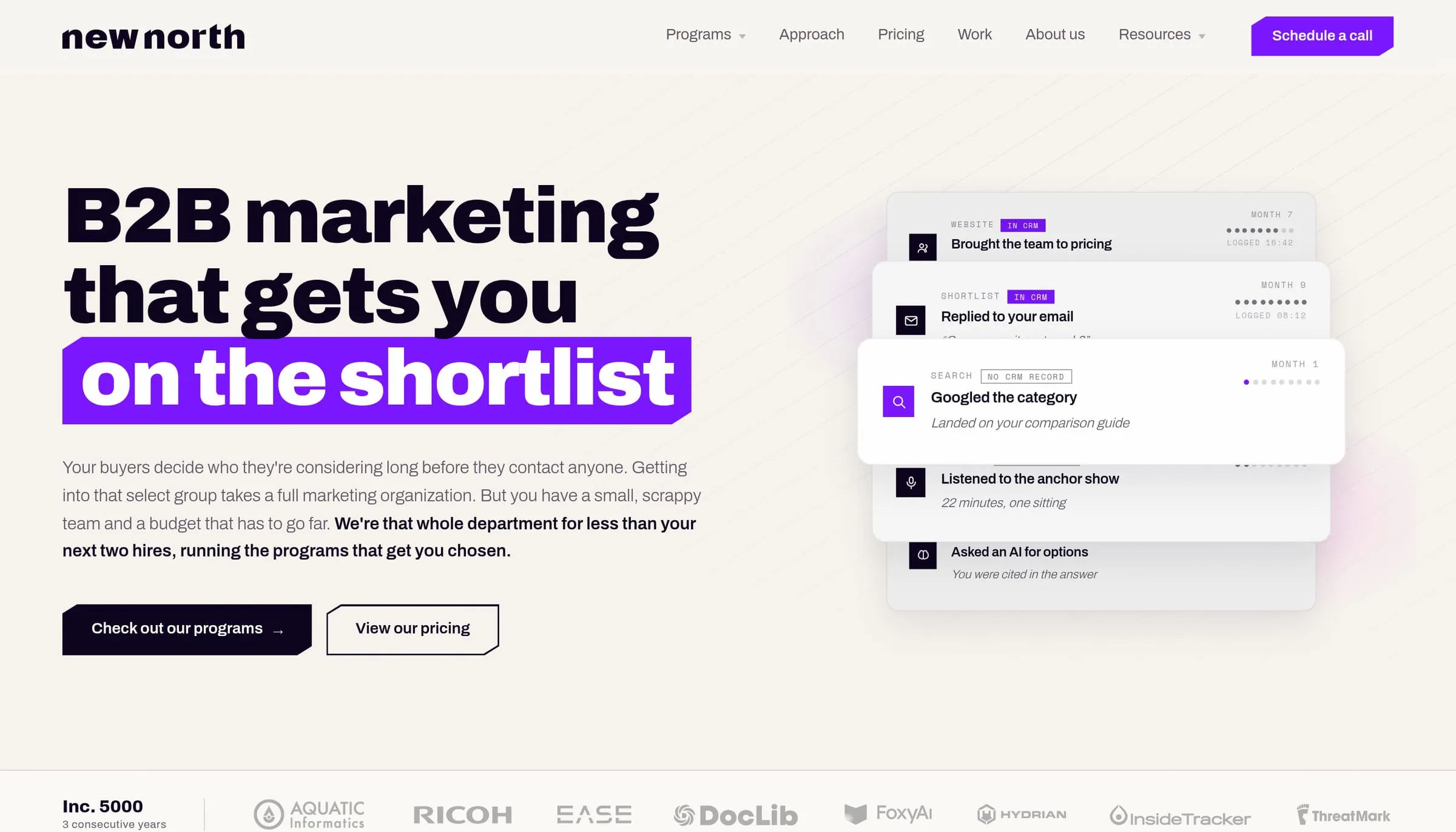
- Focus Area: Full-funnel B2B marketing strategy and execution for SaaS, tech-enabled services, and hardware, run through three programs against one diagnostic
- Website: newnorth.com
- Clutch Rating: 4.6/5
- Notable Clients: Aquatic Informatics, Ricoh Global Software, DocLib, Tyfone, FoxyAI
- Best Fit For: Growth-stage tech companies with a small internal team and high execution needs
At New North, we specialize in helping lean B2B tech teams turn marketing from a stress point into a growth engine. We don’t guarantee leads, pipeline, or closed revenue, and nobody running this kind of program can. What we do instead: build a specific forecast from your own historical and competitive data, then report against that forecast every month. That forecast doubles as our baseline, it’s built from your numbers, not an arbitrary target, so there’s something real to measure improvement against.
On team model transparency, you’re not assigned an account manager who coordinates unnamed contractors. You get named roles, strategist, writer, designer, developer, marketing ops, analyst, under one point of contact. Every task is logged in a client portal you can check any time, not just when a monthly deck arrives.
We’ve worked with SaaS companies, hardware innovators, and tech-enabled service providers to launch ABM programs, optimize marketing operations, and scale content in ways that actually move the needle. If you’re juggling strategy, execution, and reporting with a small team, we know what that’s like, and we built our model around it.
2. TECH B2B

- Focus Area: Technical marketing and digital strategy for industrial automation, robotics, and B2B manufacturing
- Website: techb2b.com
- Clutch Rating: N/A
- Notable Clients: BizLink, Omron, Soft Robotics, Cognex
- Best Fit For: Tech companies with complex products and long sales cycles
TECH B2B specializes in making complex technology easier to understand, and easier to market. From robotics and machine vision to AI and industrial automation, they translate engineering-heavy offerings into clear, compelling content that connects with technical buyers, evidence of real specialization fit rather than a generalist working outside its lane.
Their team blends technical writing, PR, digital campaigns, and trade show strategy to help you attract leads and build credibility in niche markets. If your product is complex, your market is specialized, and your internal team is stretched, TECH B2B brings the right mix of fluency and execution to fill the gap.
3. Walker Sands
- Focus Area: Outcome-based marketing and PR for B2B tech companies
- Website: walkersands.com
- Clutch Rating: 4.8/5
- Notable Clients: G2 Crowd, Raspberry Pi, Affectiva, Ensono, Sophos, Tanaka, commercetools
- Best Fit For: Growth-stage tech organizations needing full-service support
Walker Sands takes an outcome-first approach, focused on building reputation, driving demand, and delivering measurable results. They work with B2B tech companies across cloud computing, cybersecurity, fintech, and martech to bring clarity to complex offerings.
Their integrated services include PR, demand generation, content marketing, creative, digital strategy, and marketing automation. With over 200 employees and a deep bench of experts across channels, they offer the scale to act as a full strategy-and-execution partner rather than picking just one lane, worth confirming directly on a call, especially for teams juggling multiple priorities with limited bandwidth.
4. SeeResponse
- Focus Area: Inbound marketing, email strategy, automation, and demand generation for B2B SaaS and tech companies
- Website: seeresponse.com
- Clutch Rating: 4.8/5
- Notable Clients: Knack Technologies, BitTaxer, Ottertax, Curacubby
- Best Fit For: Lean marketing teams that need HubSpot support, outbound execution, and full-funnel campaign delivery
SeeResponse is a full-service B2B marketing agency with deep expertise in HubSpot, email marketing, and lead generation. Their services span everything from CRM implementation and outbound outreach to inbound strategy, ABM, and paid campaigns. Naming HubSpot specifically as their core platform is a clearer answer to the tech-stack question than most agencies volunteer upfront, though it’s worth confirming directly whether that licensing cost sits inside the retainer or outside it.
The team is particularly skilled at helping SaaS and software companies build demand programs from the ground up, focused on pipeline, not just traffic, a good example of the accountability-on-leading-indicators criterion worth confirming directly. Their agile approach and flexible team structure make them a strong partner for lean marketing departments that need execution support across multiple channels.
5. Velocity Partners
- Focus Area: Brand-first B2B marketing blended with performance campaigns
- Website: velocitypartners.com
- Clutch Rating: N/A
- Notable Clients: OnProcess, Demandbase, Workday, Monterro, Russell Reynolds
- Best Fit For: Growth-minded B2B tech teams seeking a creative and strategic partner
Velocity Partners positions itself as the partner for ambitious B2B marketers who want to build both brand and pipeline. Their approach blends bold creativity with measurable performance, built around frameworks like the B2B Marketing Manifesto and their flagship Big Beautiful B2B Blueprint, published frameworks you can review before ever getting on a call, which is its own form of proof of work.
They help teams craft messaging, creative content, digital campaigns, and SEO, while integrating analytics and martech to optimize results. Velocity thrives on partnering closely with internal teams to translate complex solutions into compelling stories, then amplify them through brand-led performance programs.
6. SageFrog
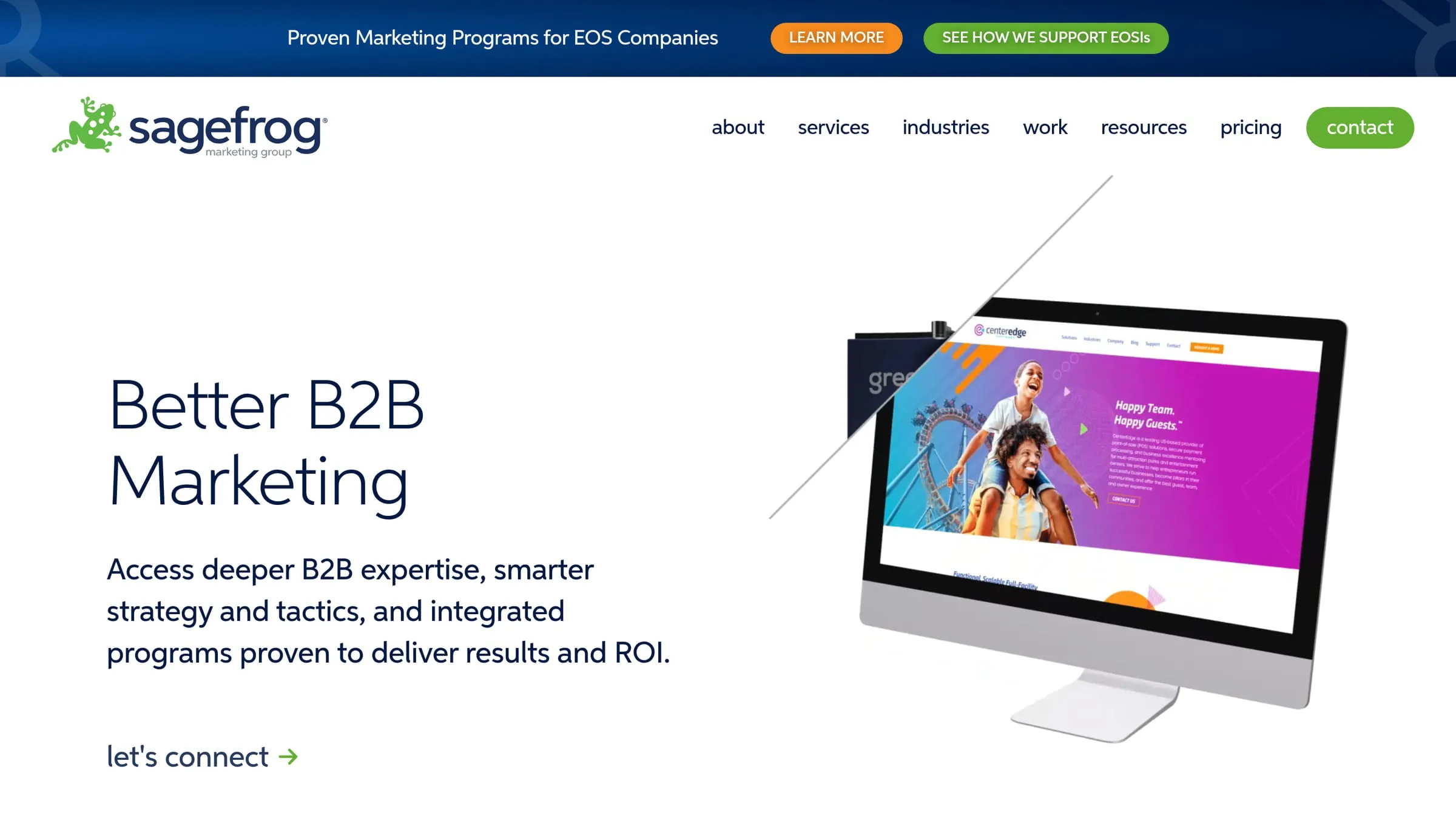
- Focus Area: Integrated B2B marketing for tech, healthcare, industrial, and professional services
- Website: sagefrog.com
- Clutch Rating: 5/5
- Notable Clients: Razor Technology, SAP, Infinitt, Brio
- Best Fit For: B2B tech firms looking for a fully integrated partner across brand, digital, and demand generation
SageFrog offers full-funnel marketing support for B2B companies looking to grow quickly and professionally. With a strong foothold in the B2B tech space, they bring together branding, inbound marketing, digital advertising, content creation, PR, and website design under one roof.
Their team is especially skilled in HubSpot implementation and optimization, helping clients get more value from their CRM and automation workflows, another agency naming its core platform directly rather than leaving the stack question vague. SageFrog also supports clients through lead generation, account-based marketing, and multi-channel campaign execution, a strategy-and-execution combination worth confirming applies end to end on your account specifically.
7. SkyRocket Group
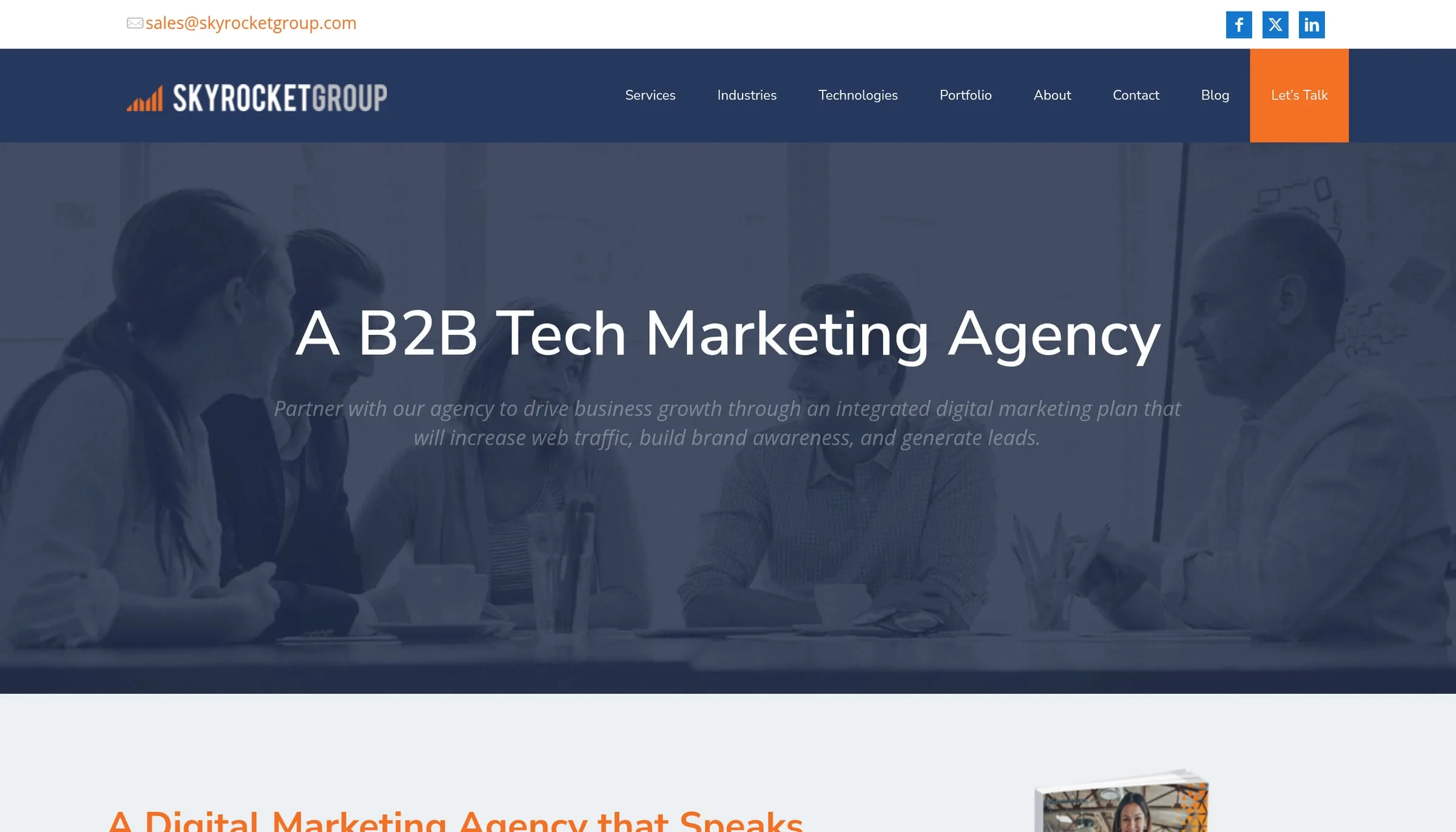
- Focus Area: Integrated digital marketing and outsourced support for niche B2B tech industries (POS, supply chain, robotics, SaaS)
- Website: skyrocketgroup.com
- Clutch Rating: N/A
- Notable Clients: Zebra Technologies, ScanForce, Datalogic, Xero
- Best Fit For: Small tech teams needing an external department to manage content, SEO, and inbound campaigns
SkyRocket Group is a boutique B2B technology marketing agency with deep expertise in verticals like payment processing, supply chain, robotics, and mobile tech. They offer full support or targeted services, everything from content and SEO to email, web design, and ongoing digital campaigns.
Their model is built for lean marketing teams: they either plug in for specific needs or serve as a complete outsourced marketing department. SkyRocket’s long-term, metrics-driven approach helps clients launch sustainable lead pipelines through consistent inbound tactics and channel optimization, worth asking to see reported against a specific forecast rather than a general trend line.
8. Yeager Marketing
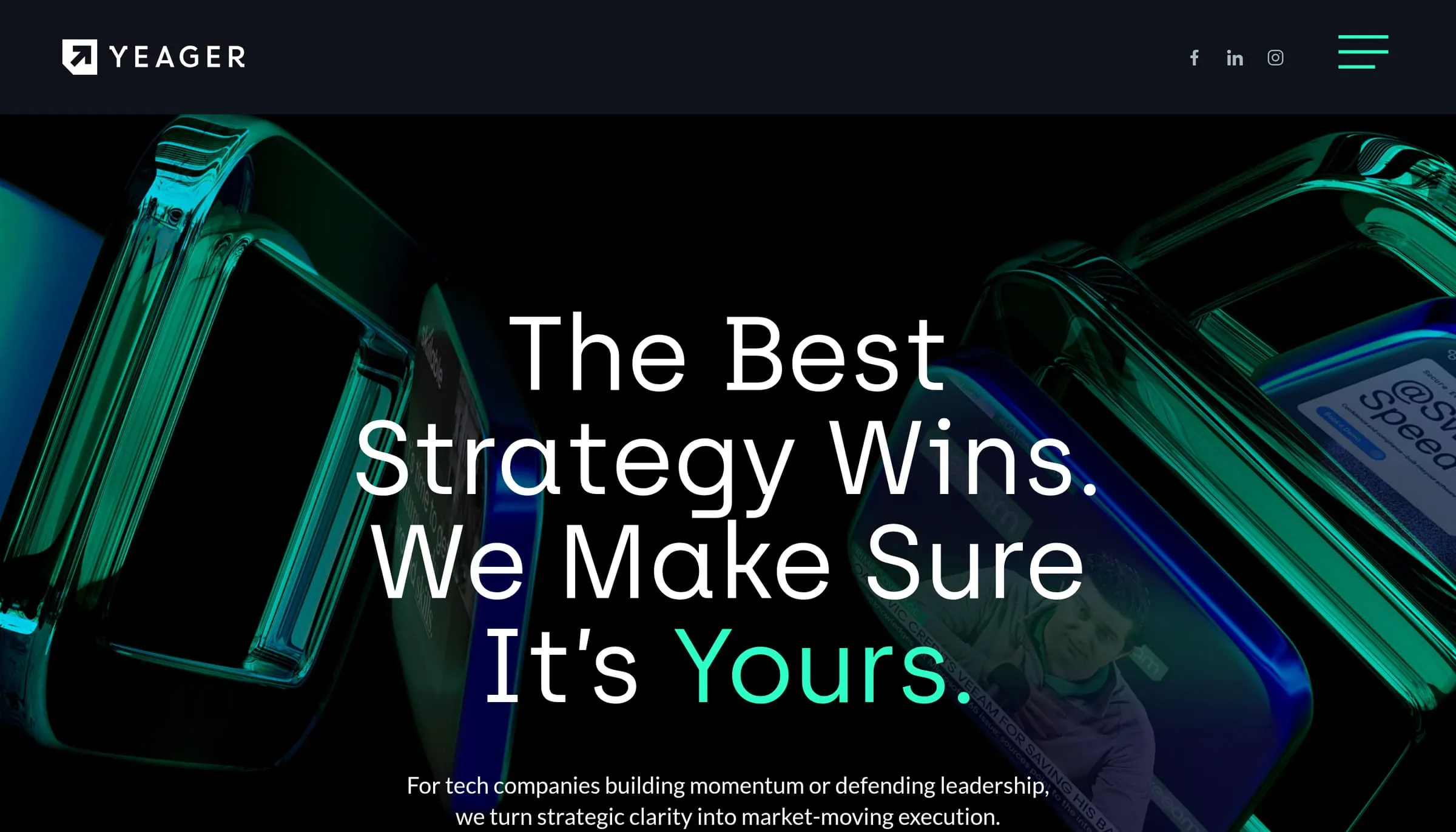
- Focus Area: Strategic B2B marketing for technology, healthcare, finance, energy, and transportation
- Website: yeagermarketing.com
- Clutch Rating: N/A
- Notable Clients: NetApp, Dell, VMware, NVIDIA
- Best Fit For: Lean tech teams operating in regulated or complex markets and needing holistic marketing support
Yeager Marketing brings award-winning marketing to complex industries like enterprise tech, healthcare, financial services, energy, and transportation. They blend branding, content, demand generation, partner and channel marketing, and market research into “GPS” packages built on top of strategic roadmaps.
With a background supporting over half of the Fortune 500 tech companies and multiple industry accolades, Yeager scales to work either as an outsourced marketing department or a targeted execution partner. For startups and mid-market tech firms needing a partner who understands intricate technologies and compliance needs, Yeager is worth a proposal review against the criteria above.
9. Bay Leaf Digital
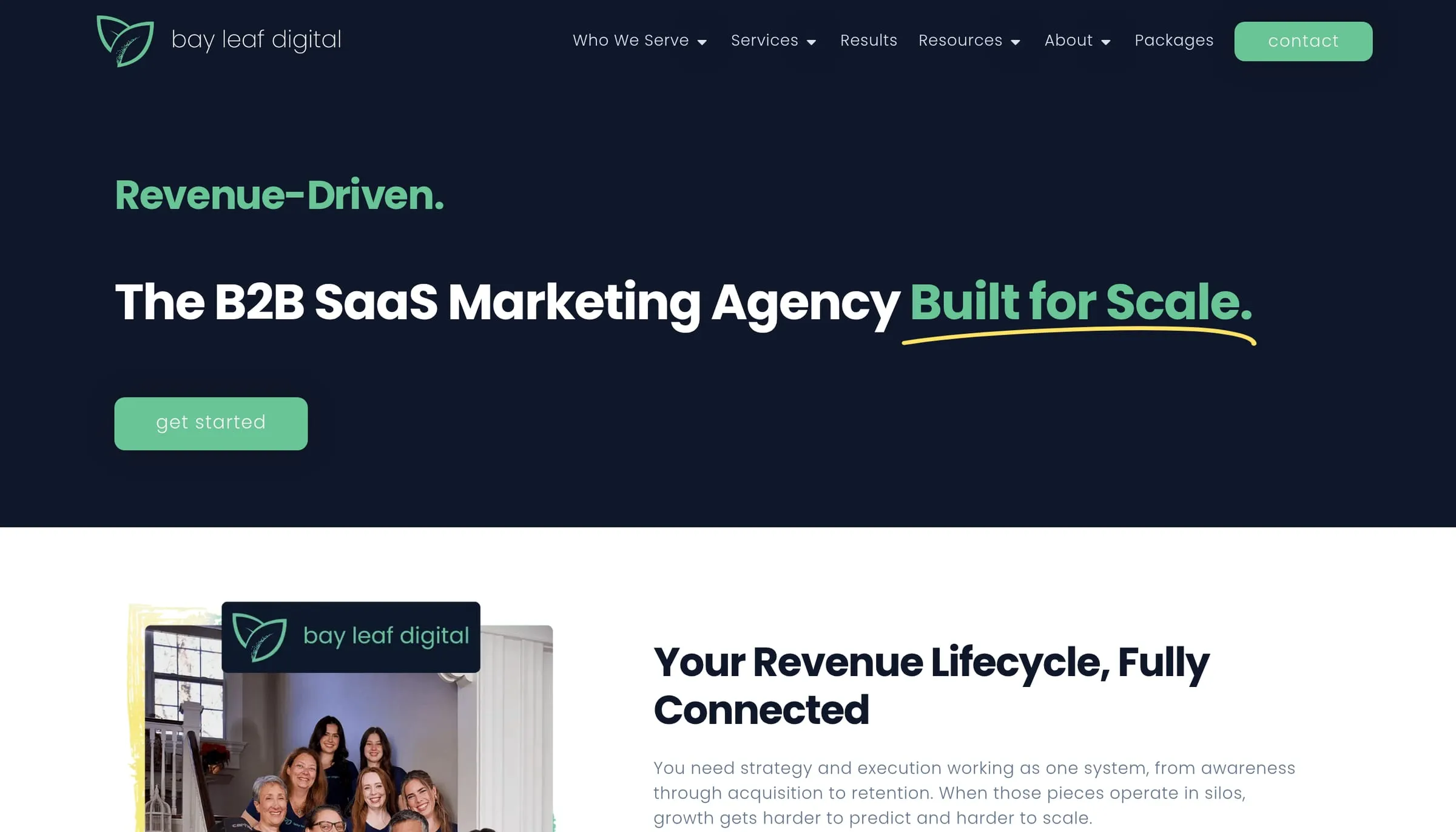
- Focus Area: Full-funnel marketing exclusively for B2B SaaS companies
- Website: bayleafdigital.com
- Clutch Rating: 5.0/5
- Notable Clients: IRS Solutions, TEXT2DRIVE, MeazureUp
- Best Fit For: B2B SaaS companies that want a senior strategist involved for the life of the account, not just the sales call
Bay Leaf Digital, based in Grapevine, Texas and founded in 2013, works exclusively with B2B SaaS companies rather than a broader tech-and-industrial mix. That narrower focus is a real specialization-fit signal, not a marketing line.
Their signature model, the “Dedicated Dual-Leader Model,” assigns every account a Growth Marketing Manager plus a Senior Strategist directly, explicitly built against the common industry pattern of a senior person closing the deal and junior staff running the account afterward. That’s a direct, checkable answer to the “who actually touches the account” criterion above. They also carry a 5.0 rating on both Clutch and Google.
Bottom Line
Bay Leaf Digital works best for B2B SaaS companies that want confirmation, in the agency’s own stated model, that a senior strategist stays on the account rather than handing it off after the contract is signed.
10. Elevation B2B
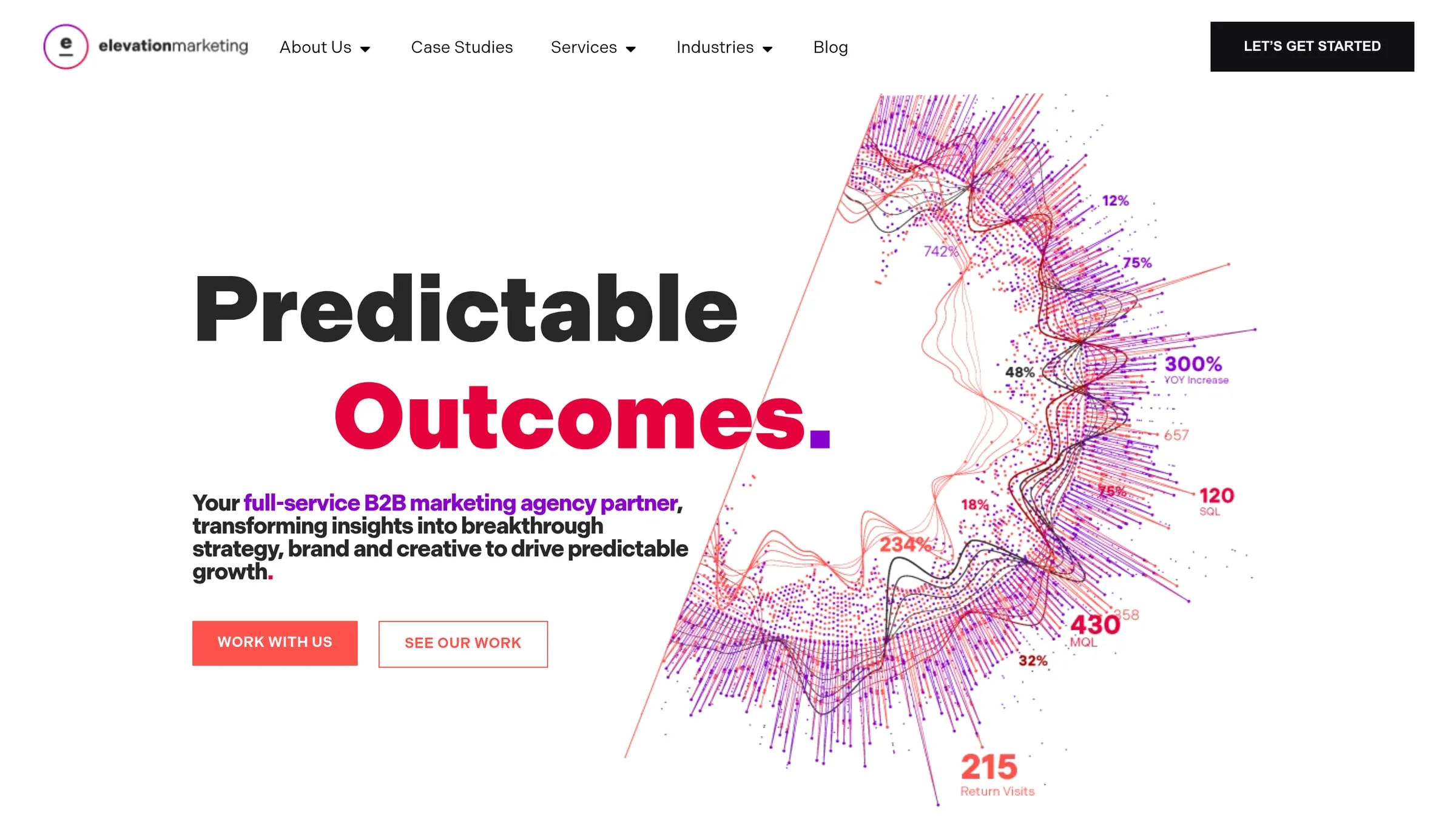
- Focus Area: Full-service B2B marketing spanning brand strategy, ABM, demand generation, marketing operations, PR, and creative
- Website: elevationb2b.com
- Clutch Rating: N/A
- Notable Clients: Amazon, Pfizer, Microsoft, GE, AWS, Red Hat (IBM), MediaTek, PointClickCare
- Best Fit For: B2B tech and enterprise companies wanting one full-service partner across brand, demand, and martech
Elevation B2B, based in Gilbert, Arizona, has operated for roughly 25 years, making it one of the more established full-service agencies on this list. Their services span brand strategy, account-based marketing, demand generation, marketing technology and operations, PR, and creative.
Their named client list includes large enterprise names like Amazon, Pfizer, Microsoft, GE, AWS, Red Hat (IBM), MediaTek, and PointClickCare, evidence of experience operating at enterprise scale and complexity across a mix of technical and non-technical buyers.
Bottom Line
Elevation B2B works best for B2B tech and enterprise companies that want a long-established, full-service partner covering brand, demand generation, and marketing operations under one roof.
11. Kalungi
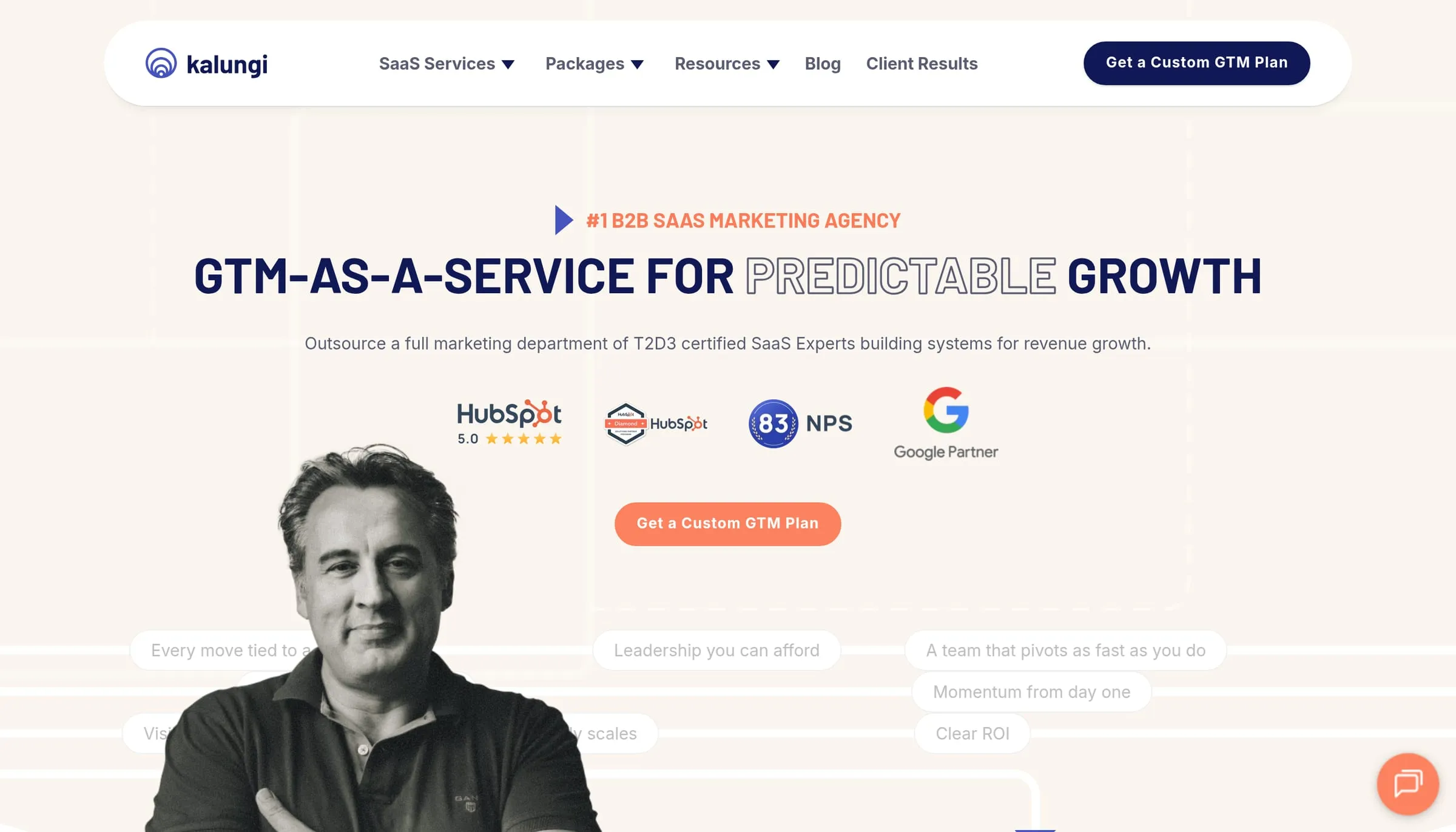
- Focus Area: Full-service marketing exclusively for B2B SaaS companies
- Website: kalungi.com
- Clutch Rating: N/A
- Notable Clients: DataGuard, Patch, Botdojo, Beezy, CPGvision, Avid, Fraxion, One Click Contractor, Aware360
- Best Fit For: B2B SaaS companies wanting either full outsourced execution, embedded senior leadership, or a self-serve playbook
Kalungi, based in Kirkland, Washington, positions itself as “the world’s only full-service B2B SaaS marketing agency,” working exclusively with B2B SaaS rather than a broader technology mix. They run a named GTM growth methodology called “T2D3,” also published as a standalone playbook, and offer three distinct engagement tiers: Full-Service (they run everything, described as replacing 10+ hires, with a pay-per-performance option available), Syntropy (senior GTM leadership embedded alongside the client’s own in-house execution team), and T2D3 (the client executes independently using Kalungi’s own templates and playbooks). Naming three separate, structurally different engagement models is a clearer answer to the strategy-execution-model criterion than most agencies give.
Kalungi publishes case studies with stated results, DataGuard (330% MQL growth, $4M in pipeline) and Patch (1,500% MQL growth) among them, alongside other named clients including Botdojo, Beezy, CPGvision, Avid, Fraxion, One Click Contractor, and Aware360. The agency also holds HubSpot Diamond Partner and Google Partner status.
Bottom Line
Kalungi works best for B2B SaaS companies that want to choose their own level of involvement, from fully outsourced execution to embedded senior leadership to a self-serve playbook, from a specialist that works exclusively in SaaS.
12. Foundation
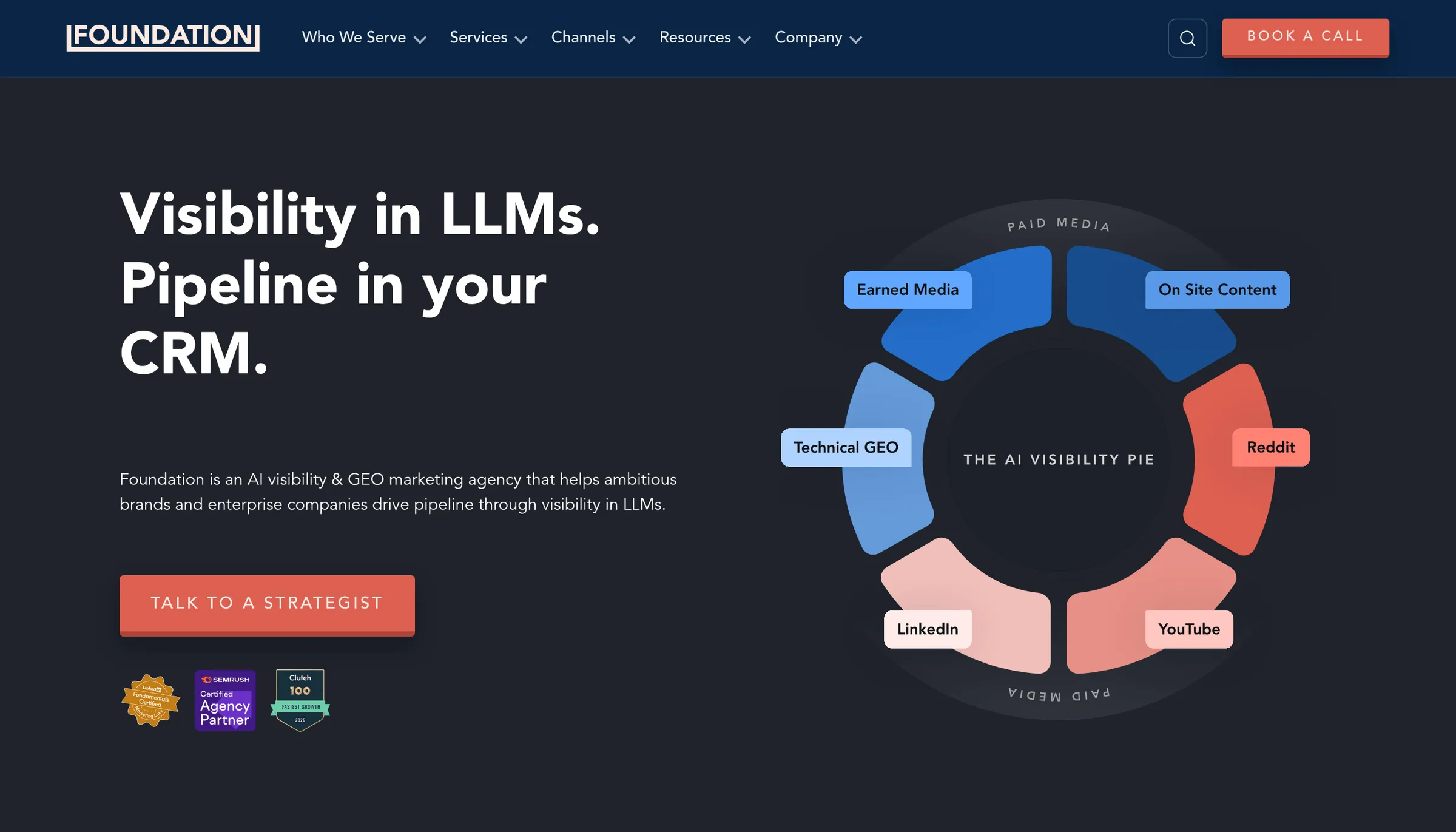
- Focus Area: AI visibility and Generative Engine Optimization (GEO) for B2B SaaS and tech companies, alongside content marketing, digital PR, demand generation, paid media, and technical SEO
- Website: foundationinc.co
- Clutch Rating: 2026 Clutch Award recipient (per Foundation’s own site badge)
- Notable Clients: Webex, Mailchimp, Snowflake, Canva, Procore, Bitly
- Best Fit For: B2B SaaS and tech companies specifically prioritizing visibility in AI answer engines alongside traditional search
Foundation, based in Philadelphia, positions itself specifically around getting B2B SaaS and tech brands cited in ChatGPT, Gemini, Claude, Perplexity, and Google AI Overviews, in addition to more traditional services like content marketing, digital PR, demand generation, paid media, and technical SEO. That AI-visibility focus is a genuinely different specialization than most agencies on this list offer as a named, dedicated service rather than an afterthought.
Their named clients, Webex, Mailchimp, Snowflake, Canva, Procore, and Bitly, are established SaaS and tech brands, and the agency states it received a 2026 Clutch Award.
Bottom Line
Foundation works best for B2B SaaS and tech companies that specifically want a partner treating AI answer-engine visibility as a named, dedicated discipline, not just traditional SEO with an AI label added on.
13. Directive Consulting
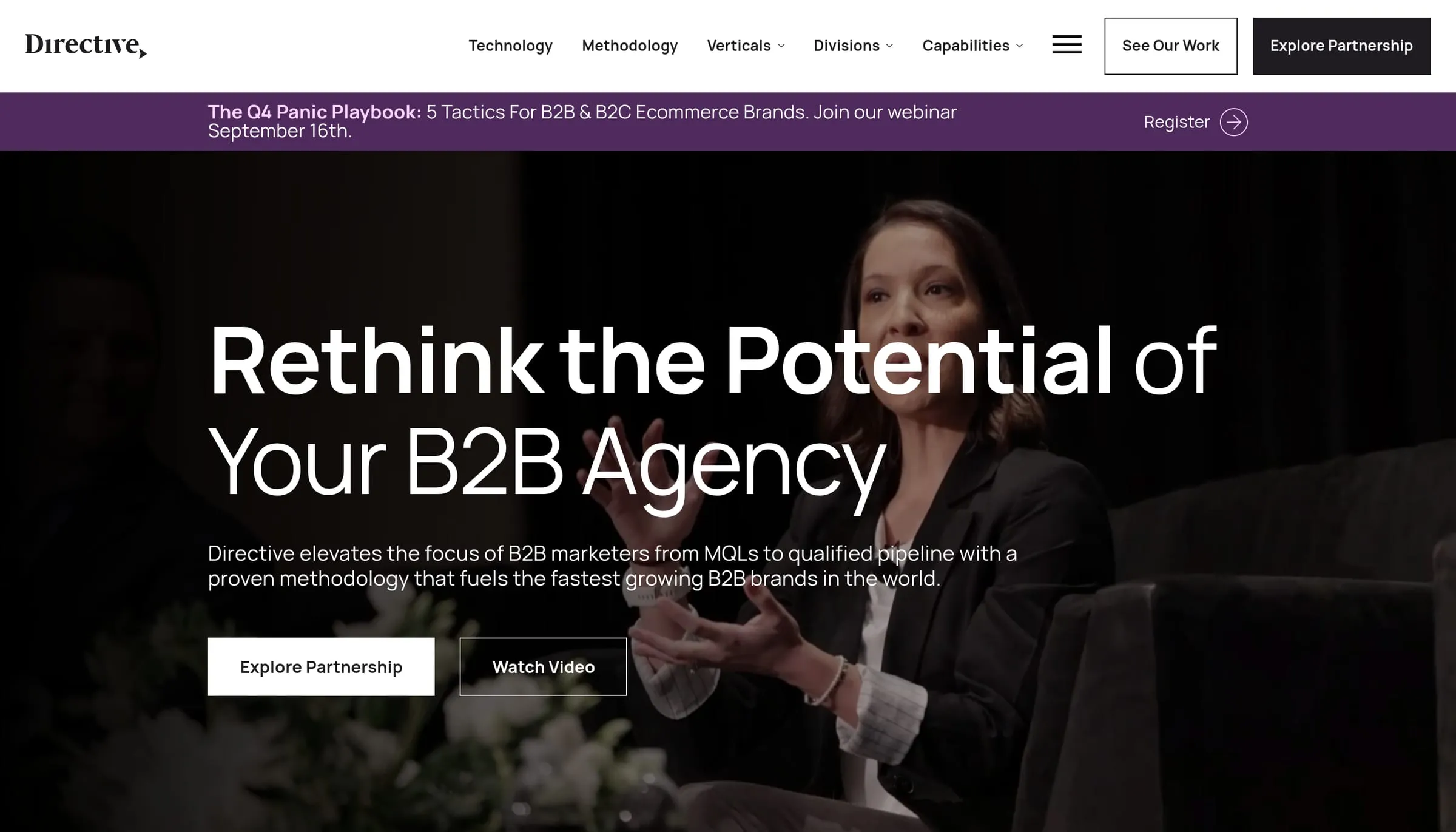
- Focus Area: Performance marketing for B2B SaaS and tech companies, organized into Performance, Commerce, and Communications divisions
- Website: directiveconsulting.com
- Clutch Rating: 4.8/5 (review count not independently confirmed)
- Notable Clients: Amazon, Gong, HP, and Seagate (per Directive’s own Success Stories page); Toast, Ahrefs, Common Room, and Strapi (per independent third-party coverage)
- Best Fit For: B2B SaaS and tech companies wanting a larger, multi-office agency with dedicated SaaS specialization
Directive Consulting, founded in 2013 by Garrett Mehrguth (Founder & CEO), describes its own growth from a $12-a-day bootstrapped budget to what it now calls a $25M agency. The company has offices in Orange County (HQ), Austin, New York City, Mexico City, London, and Toronto, and organizes its work into three divisions, Performance, Commerce, and Communications, spanning content, paid media, revenue operations, and more.
They run a dedicated “SaaS Marketing Agency” service line alongside named Account-Based Marketing and Demand Generation offerings built specifically for B2B SaaS and tech companies, rather than treating tech as one vertical among many.
Bottom Line
Directive Consulting works best for B2B SaaS and tech companies that want ABM and demand generation handled by a larger, multi-office agency with a dedicated SaaS specialization and broader performance marketing capability beyond any single channel.
14. Six & Flow
- Focus Area: Strategic HubSpot consultancy spanning HubSpot implementation, RevOps, and data and technology consulting
- Website: sixandflow.com
- Clutch Rating: N/A
- Notable Clients: Autotrader, University of Cambridge, Smeg, Markel, Canadian Red Cross, Ocado, CFO Centre
- Best Fit For: B2B tech companies wanting deep HubSpot expertise from a certified, security-vetted partner
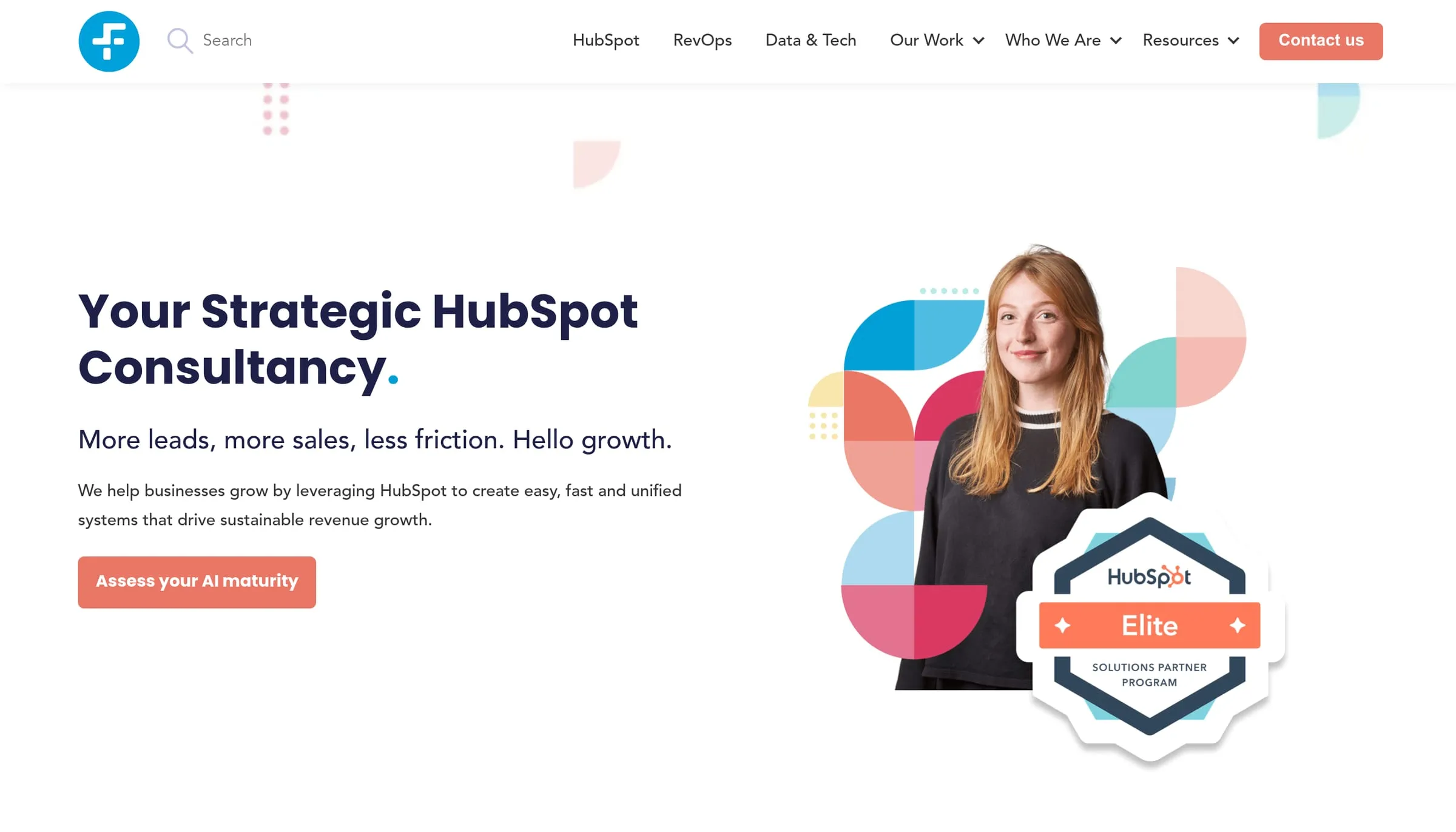
Six & Flow, headquartered in Manchester, UK with additional offices in London, Amsterdam, Dublin, Toronto, and Vancouver, positions itself as a “Strategic HubSpot Consultancy” and HubSpot Elite Partner with 10+ years of experience. Their work spans three core practice areas: HubSpot implementation and optimization, RevOps (revenue operations, demand generation, and sales enablement), and Data & Tech (data consulting, systems integrations, and GTM technology). They state they’ve delivered 513+ HubSpot projects with 114+ certified HubSpot experts on staff, and run a named “FLAIR Framework” for AI adoption across marketing, sales, and service, another example of a published methodology functioning as proof of work, in the same vein as Velocity Partners’ frameworks above.
One differentiator worth naming directly: Six & Flow holds ISO 27001:2022 certification for information security management, a credential neither of the other HubSpot-focused agencies on this list (SeeResponse, SageFrog) states. For B2B tech companies where data handling and security review are part of vendor selection, that’s a checkable point the others don’t offer. They maintain a dedicated B2B industry page alongside verticals in software, professional services, recruitment, manufacturing, automotive, real estate, and non-profit, and list case studies with clients including Autotrader, the University of Cambridge, Smeg, Markel, the Canadian Red Cross, Ocado, and CFO Centre.
Bottom Line
Six & Flow works best for B2B tech companies that want deep, certified HubSpot expertise across implementation and RevOps, and for whom a named security certification is a genuine factor in vendor selection.
Best Fit by Use Case
| Use Case | Recommended Agency | Why |
|---|---|---|
| You need strategy + execution under one roof | New North | Built for lean tech teams needing end-to-end marketing support |
| You sell highly technical products | TECH B2B | Specializes in robotics, automation, and translating complex content |
| You need integrated PR, brand, and demand | Walker Sands | Large-scale agency with strong multi-channel execution |
| You’re on HubSpot and need full-funnel help | SeeResponse | Certified partner with strong execution in email, automation, ABM |
| You want brand-led growth with bold ideas | Velocity Partners | Experts in messaging, storytelling, and creative campaigns |
| You need website, brand, and inbound support | SageFrog | Balanced execution across brand, digital, and HubSpot-based growth |
| You need a marketing department-as-a-service | SkyRocket Group | Acts as a plug-and-play team for long-term inbound execution |
| You’re in a regulated or complex industry | Yeager Marketing | Experienced with large tech, finance, and compliance-heavy sectors |
| You want a senior strategist on the account for the long haul | Bay Leaf Digital | Dedicated Dual-Leader Model pairs a Growth Marketing Manager with a Senior Strategist |
| You need an established, full-service partner at enterprise scale | Elevation B2B | ~25 years operating, with enterprise clients across brand, ABM, and demand gen |
| You want to choose your own level of involvement | Kalungi | Full-Service, Syntropy, or T2D3 self-serve tiers, all exclusive to B2B SaaS |
| You want visibility in AI answer engines, not just search | Foundation | Dedicated GEO/AI-visibility discipline alongside traditional SEO and content |
| You want a larger, multi-office SaaS-specialized partner | Directive Consulting | Three-division structure (Performance, Commerce, Communications) with a dedicated SaaS line |
| You need deep HubSpot expertise plus a security certification | Six & Flow | HubSpot Elite Partner, 513+ HubSpot projects delivered, ISO 27001:2022 certified |
Choosing the Right Technology Marketing Agency
For lean B2B tech teams, the right agency isn’t just a vendor, it’s a force multiplier. Whether you’re building pipeline, clarifying your message, launching ABM, or finally operationalizing HubSpot, the agencies on this list are equipped to meet you where you are.
But the agency you pick matters less than the questions you ask before you pick one. Run every finalist through the twelve criteria above: who’s on the account, what they’re accountable for, how they price a scope change, whether they’ll show you a forecast instead of a promise, and whether they can show you a real baseline instead of a made-up number. Choose wisely, and the partnership does the work of an in-house team you don’t have the budget to hire.
If you want a second opinion on your shortlist, or you want to run your own proposals through this exact methodology with someone who isn’t trying to win the business, that’s a conversation we’re glad to have.
FAQ
What's the difference between a B2B technology marketing agency and a generalist digital marketing agency?
How do I evaluate a B2B digital marketing agency's proposal?
Should I expect a guaranteed number of leads or pipeline from a B2B marketing agency?
How long should it take to see results from a technology marketing agency?
What's a reasonable monthly budget or engagement size to expect?
Should I choose a specialist boutique agency or a larger multi-office agency?
What's the difference between a technology marketing agency and an ABM-specialist agency?
How do I know if an agency's tech stack fits with what we already use?
What should I do if none of these 14 agencies feels like the right fit?