Start with an agency if you need help with strategy. Chris Corcoran says an agency gives you an expert for a fraction of the cost, while a junior hire will look to you to come up with the strategy. Bring a function in-house once the company is big enough or the function is strategically important, and either way, the tighter you manage it, the better the results.
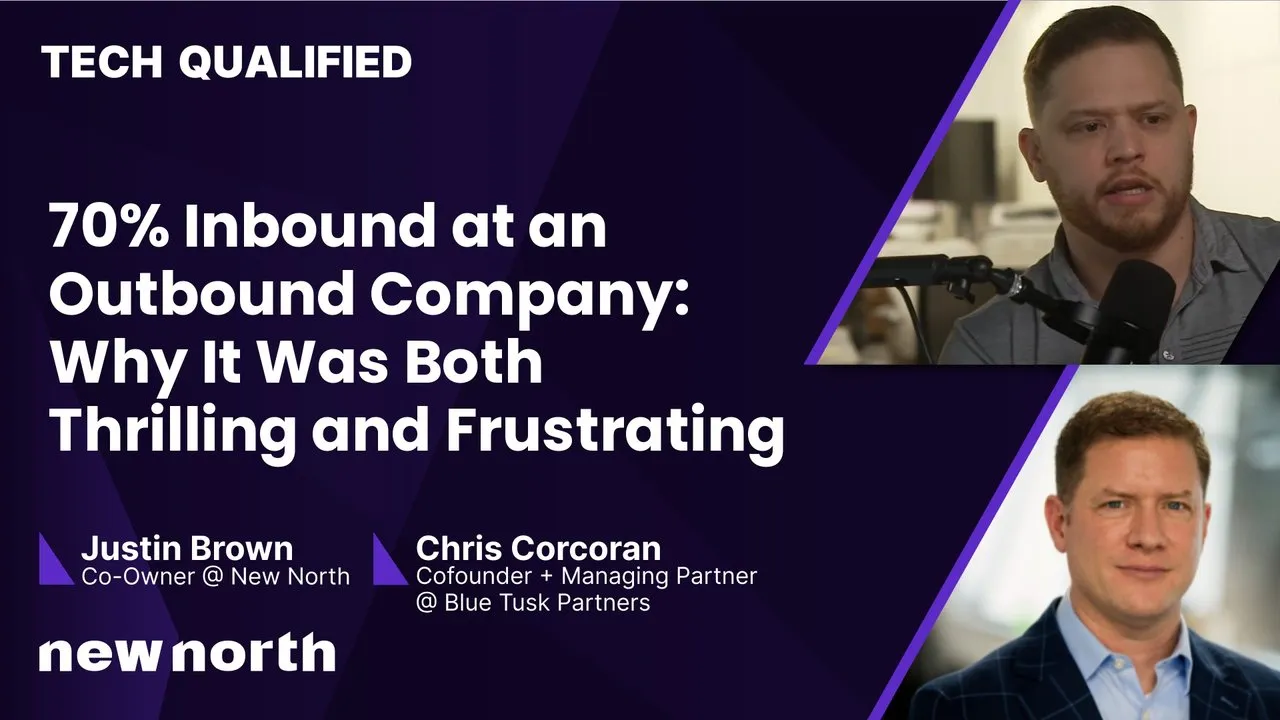
In this episode of Tech Qualified, host Justin Brown sits down with Chris Corcoran, Cofounder and Managing Partner at Blue Tusk Partners, to unpack more than two decades of growing a B2B services company without a big marketing organization. Chris walks through how memoryBlue’s marketing evolved: a word of mouth era built on client referrals, early agency partnerships, a standout junior hire, and finally an in house team led by a director of marketing.
The conversation covers the realities of being a sales led founder: how memoryBlue stood out in a crowded SDR outsourcing market, why the website became its best salesperson and recruiter, and how 70 to 80 percent of the business came in through inbound at an outbound company. Chris also explains why the tighter founders manage their agencies, the better the results.
For founders and small teams deciding whether to hire, outsource or do it themselves, this is an honest look at what scaling marketing actually looks like with limited resources.
Chris spent more than two decades helping build memoryBlue into one of the best known outsourced SDR firms, with a front row seat to nearly every growth challenge a B2B services company faces.

What Chris says about in-house vs agency marketing
Word of Mouth Has a Ceiling
For nearly a decade, memoryBlue’s marketing was simply exceeding client expectations. It worked until the founders had to choose between staying a small lifestyle business and investing to scale. Word of mouth is free and high trust, but it cannot be turned up on demand. If growth is the goal, marketing investment is not optional.
The Tighter You Manage Your Agency, the Better the Outcome
Chris argues the best agency relationships are the ones where the founder stays deeply involved. Agencies are not a way to take marketing off your plate. They multiply your strategic input with specialist execution, and they work about as well as you show up for them.
Differentiation Lives in the Business Model, Not the Tagline
When asked what makes them different, most services firms say “our people”, which is what every competitor says. memoryBlue let clients hire their SDRs and recruited straight out of college. Those were structural choices competitors could not copy with a straight face.
Great Junior Talent Needs Real Leadership
One of Chris’s best marketing investments was an exceptional hire straight out of school. She made an impact fast but left to work for a marketing leader she could learn from. If you hire a first marketer, be honest about whether you can mentor them, or pair them with senior help.
Jump to the moment
Lifestyle Business or Scale?
The meeting with memoryBlue’s fractional CFO where the founders decided to scale, and with it, to invest in marketing and a sales team.
Once we made the decision that we wanted to scale the business, we knew that we were gonna have to invest in marketing.
Why an Agency Before a Junior Hire
A generalist founder cannot be the strategist, and a junior hire will look to the founder for strategy. An agency brings an expert for a fraction of the cost.
The return on investment, you're getting an expert, but you only have to pay for a fraction of the cost.
Don’t Blame the Barber
Advice from Chris’s dad that shaped how he managed every agency relationship.
Don't blame the barber for a bad haircut. The barber's doing exactly what you tell him to do.
The Inbound Paradox
An outbound firm that won most of its business through inbound, and why Chris both loved and hated that.
We ran an outbound company, but yet 70 to 80% of our business was inbound. I loved that and I hated it.
What He Would Tell His Year One Self
Start earlier and invest more.
Questions this episode answers
Should a founder hire a marketer or an agency first?
When should marketing move in-house?
How involved should a founder be with their agency?
Is hiring a marketer straight out of college a good idea?
How long should you test a marketing channel before pulling the plug?
Read the full transcript
Chris Corcoran: We ran an outbound company, but yet 70 to 80% of our business was inbound. Of mouth. That, but I always wished that we could go out and get more through outbound channels, because that would’ve just helped us grow even faster.
Justin Brown: Hello and welcome to another episode of Tech Qualified. My name is Justin Brown, and this episode is brought to you by New North. New North helps small, scrappy B2B tech marketing teams build real marketing functions through strategy and execution across content, paid, ABM, and reporting.
Today, I’m joined by Chris Corcoran. Chris spent more than two decades helping build memoryBlue into one of the most recognizable outsourced SDR firms in probably the world. During that time, he had a front-row seat and actually led much of the function for nearly every growth challenge a scaling company can face, from founder-led sales to building marketing programs to experimenting with agencies, content, PR, events, podcasts, and everything in between.
So today, we’re going to talk about what actually worked, what didn’t, and what he learned after twenty-four years of trying to grow a B2B company without a massive marketing organization behind him. So Chris, welcome to the show.
Chris Corcoran: Justin, thanks for having me. I’m thrilled to be here.
Justin Brown: Yeah. So I’m gonna start this interview with the question that I start every interview. What does scrappy marketing mean to you?
Chris Corcoran: Getting everything you possibly can out of all you got.
Justin Brown: Love it. So let’s talk about that. So when memoryBlue was first getting off the ground, and for the audience, I was there actually pretty early on. I started my career as an SDR cold calling for Hitachi Data Systems trying to sell people storage. So I saw the world of marketing or the lack thereof that we had early on at memoryBlue. But what did marketing look like early on?
Chris Corcoran: Well, initially, entire marketing philosophy was simply exceed our clients’ expectations regardless of how high those expectations might be by providing remarkable service. And we were doing that because we wanted to keep our clients, and we wanted to generate word of mouth, and that helped us out probably for the first decade. But you can only scale so much when you’re operating with that philosophy. You’re gonna have to start doing some marketing programs, which we eventually started to do.
Justin Brown: Yeah, it’s interesting. A lot of our clients, they basically have one of two ways that they’re growing when they come to us. One is either that they’re a heavily sales-led organization, maybe with, like, one person in marketing, or it’s a split function across founder, head of client services, et cetera, or the sales program. So when did you decide that for you, word of mouth was the, kind of the approach that you were taking, when did you determine that that wasn’t enough and that you needed some form of marketing?
Chris Corcoran: This was probably seven, eight years in, and we had a meeting with our fractional CFO, and we were making the decision on do we wanna stay really, really small and manageable and kinda keep all of our profits and really run a lifestyle business, or do we wanna try to go and scale the business? Once we made the decision that we wanted to scale the business, we knew that we were gonna have to invest in marketing, we were gonna have to invest in building out a sales team, and so that was the decision we made.
Justin Brown: And what was the first real marketing initiative that you invested in?
Chris Corcoran: Well, as a founder, you’re kind of a generalist, right? You know a little bit about a lot of things, but you’re not a specialist. And we knew that from a marketing standpoint, we would need to find a specialist. And so we could either hire someone full-time or we can try an agency.
And the agency was super attractive because you can turn it on, turn it off, you can get someone who’s way more skilled to work with you. And so we started exploring agencies and we ended up finding an agency that we worked with, and it worked really well for us.
Justin Brown: Yeah. So, let’s just dig into that a little bit. So I mean, it’s something that I deal with all the time, the way that we’re positioned as an organization and our price essentially is mid to low level marketer, is someone that they could hire, and then that person would work with the founder, and then essentially the founder would have to really be leading marketing strategy because that junior person isn’t, they may have some ideas, but they’re not going to have ideas that at that stage of their career, if someone is $6,000 to $7,000 a month, it’s gonna be, “Hey Chris, so I was in college three years ago. Here’s how we’re gonna scale the business.” So what led to some of your decisions to go agency route versus that in-house route?
Chris Corcoran: The return on investment, you’re getting an expert, but you only have to pay for a fraction of the cost. So you can get just a little bit of that individual’s time, and they have a team, and they have resources, and they have know-how. Versus if you hire somebody, if you hire someone junior, they’re gonna be looking at you to come up with a, the strategy, and we needed help with the strategy. And so that’s why we decided to go the agency route.
Justin Brown: Yeah, it’s interesting.
Chris Corcoran: And things changed over time, too. Like, we also brought folks in-house and built a team. So we did a variety of different things.
Justin Brown: Yeah. You know, again, for the audience, I’ve worked with Chris in a variety of capacities for 10 years, 15 years. We were an agency for Chris where we worked with members of the memoryBlue team. I’ve worked for Chris. I’ve kind of seen it, right? So you had this director of marketing, and the director of marketing actually left, so there’s like you, you’ve kind of seen it all. It’s one of the reasons why when I was thinking about people I wanted to bring onto the show, that I wanted to bring you on.
You’ve essentially seen the three flavors that we see with our clients. You had the agency in place. You had a director of marketing, who I assume was spearheading, at a minimum, some of the strategy. And then you also had, after that director left, some junior people, mid-level to junior people in place who were, had focus on different areas of your marketing function.
I’d be curious to have you take the audience through those three different approaches and maybe some of the pros and cons to each in comparison to each other. And I can prompt you on them if you want. That in-house leader, the agency, and then having, I don’t know. When you had a handful of junior people, I’ll ask you this before I jump into the full question.
When you had the handful of people, ‘cause I saw it from the outside, we were actually doing the memoryBlue podcast, Tech Sales is for Hustlers, so I just knew who I engaged with, and this was after their director of marketing, Kevin, had left. Did you have a leader at that point, or were they all reporting basically to you, or how did that work?
Chris Corcoran: Yeah, they were essentially reporting into me.
Justin Brown: Okay.
Chris Corcoran: I really liked the return on it, and it was short-lived, but I would say an elite individual. We hired, I would say, an elite individual right out of undergrad.
Justin Brown: Yeah.
Chris Corcoran: And what was great was we got, she was exceptional, super ambitious, driven, made a huge impact. The challenge was it was only short-lived was because she was reporting to me.
Justin Brown: Yep.
Chris Corcoran: Like, she wanted to go work for a marketing superstar, and I’m not that. But she was exceptional, and so I was disappointed that I couldn’t have been a better leader for her. But she did an amazing job and you can really get a big bang for the buck if you go and not just hire anyone out of college. You go find the best person you possibly can coming right out of college and give them opportunity, and they will rise to the occasion.
And maybe if you can provide a little bit more mentoring than I was able to provide, you can keep that person longer term. That was an exceptional run. I would do that again in a heartbeat.
Justin Brown: Yeah. And it’s interesting, I actually talk to people about this a lot. I bring this up when I’m on sales calls that are, and I’m pitching our service, and I show this slide and it’s got this lady and she’s, like, split. Like, left side is robot and right side is, like, business professional woman, and it’s got all these different skill sets on there. It’s like web dev, design, copywriting, strategy, so on and so forth.
And I’m like, “Look, if you find this person, I will hire them tomorrow.” The reality is, A, they’re incredibly hard to find, and B, they’re incredibly hard to retain because you need to have a great environment for them. And the people who I’m talking to on most occasions are in your boat, where it’s a founder looking for the way to do marketing at their organization. So even if they bring this person in, then that person, are they gonna stay? And then when they leave, is marketing off? What happens in that situation?
It’s funny, I actually bring that up a lot because it’s true. It’s what I say to people when, we still do a lot of podcasts and, you know, people go to bring their podcast in-house. And I try to just talk them off that ledge ‘cause I’m like, “Look, you say you have somebody right now who’s gonna do your podcast, and are they gonna do your podcast? Sure. They’ll do it for three months. They’ll do it for six months.
“By month nine of them cutting your face and turning you into a clip video, they’re gonna be so bored to tears because they’re one of two things. They’re either a marketer who has other aspirations other than just editing your audio and video every single week, or they’re a video person. And trust me, those people wanna go out and do crea-, like they wanna do highly creative work.”
And so, you know, when you work with an agency that has a system, you have a little bit less risk of that superstar up and leaves, and then you’re sitting there kinda holding the bag going like, “Man, we were doing some great things, but now I have to reset.” And so, you know, I think having that infrastructure is very key.
So, okay, so we talked about having the junior person who’s a superstar coming in but then reporting to you, maybe they needed some leadership. And then you had your, I think you built up at least a handful of people on a team with a director. What was that like?
Chris Corcoran: Well, with that approach, you have a lot more control over things and it’s just like outsourcing in general. I think once your organization or your company gets big enough, it makes sense to start bringing some functions in-house. And you see it with really big companies, right? Like they bring, they have a lawyer on staff, right? We never got that big. But something becomes strategically important enough to you, you can bring it in-house.
We work with agencies throughout, for podcasts, through SEO, for all sorts of different things. And I will say is, one of the things that I learned through the process is, well, maybe this is my personality, but the tighter you manage the agency, the better results you’re gonna get, right? Because some people just feel like they can just write a check every month, and like, all their problems are gonna go away.
You have to treat the agency almost like a direct report. You have to be involved, someone on your team has to be involved to drive that. And if you’re not that involved, you’re not gonna get the results that you want.
Justin Brown: And can I chime in on that, actually, as an agency owner?
Chris Corcoran: Yeah, absolutely.
Justin Brown: I agree. So funny. It’s like, I think that sometimes our clients, either purposefully or thinking that they’re doing us a service, they’re less involved and we’re sitting here like, “No, we need your buy-in.” I mean, we need to know that this is what you want to do. We need you to review this work. ‘Cause the last thing I wanna have happen is something goes out on your behalf, and it had some faux pas that I don’t know about. I don’t work there.
No matter how, I could go and do marketing for another marketing agency, and they’re gonna have unique things about their organization that I don’t know about, but yes, I want your buy-in on it. Or, Chris, in your situation, if I’m your marketing agency after twenty years, the amount of just inherent knowledge that you have about your ICP, about the way you like to position your organization, like those are valuable adds for my team to know that it’s not that we don’t have a certain skill set that we, like, we just know we don’t know everything.
And we know marketing strategies, we know approaches, we know how to connect things from HubSpot to every tool on Earth to be able to report on it. But getting those insights from you, our clients that are the most successful are the clients who have somebody who is intimately involved with the things that we’re doing. And I think a lot of our challenges stem from situations where a founder thinks, “I am just going to bring on a marketing agency, and then they need to drive leads.” And that’s probably like the most common one that we see.
And I’m just like, if it was that easy, and sometimes I say this and have to watch myself, but I’m like, always say to me, they’re like, and I’m sure you’ve heard the same thing, “Justin, if we can find a way where we can get ROI on the marketing we’re doing, we’ll increase spend tomorrow.” I’m like, “If I could promise that, I would be a billionaire.” Like, we need your inputs. We need to learn. We need to evolve. We need to grow.
So, I think that’s just an interesting nugget that I, as an agency owner, I agree. The more involved you are, the better, not the worse, which is, I think, the opposite of what people think an agency would want.
Chris Corcoran: Yeah, totally. So growing up, my dad used to always say, “Chris, don’t blame the barber for your for a bad haircut. The barber’s doing exactly what you tell him to do.”
Justin Brown: Yeah.
Chris Corcoran: Right? And so it’s with the agencies, right? And when, think back of kind of like the people I’ve worked with, the absolute best people I’ve ever worked with wanted to work with me all the time. Like, they didn’t want me not working with them. Like, they were always outside my office, knocking on my door, wanting to get me involved, and those were the most talented people.
They wanted involvement, to collaborate, to work together. And I think you have to have that same sort of relationship with your agency, or whoever you’re working with, your director of marketing. But you need to be hand in glove with your marketing resources to really drive the outcome that you’re looking for.
Justin Brown: Yeah, absolutely. One of the things that I wanna ask you about, because, coming from, for you, you came from a sales background, as did I. And marketing strategy means a lot of different things to a lot of different people. I certainly have my take on what marketing strategy is. How did you set strategy for memoryBlue when it came specifically to your marketing function?
Chris Corcoran: Well, so we’re probably like a lot of your clients, we’re a professional services company. And well, what differentiates one services company from another? Well, typically it’s gonna be around your people. So we try to very clearly differentiate ourselves from other providers by, number one, we wanted to productize our service. I think we did a pretty good job of that.
And we really differentiated ourselves from all of our competitors by really letting our clients hire our people if they wanted to. And most of our competitors would say if you hired our, one of our employees, it would be like $100,000. And so we leaned into that and said, “Hey, listen, we’re gonna completely differentiate ourselves. We’re gonna let our clients hire our people if they want to, and we’re gonna try to go and hire the best people, and we’re gonna do that by hiring people right out of college, as opposed to getting these lifers or squatters who are in their 40s and they’re still doing an entry-level job.”
So from a strategy standpoint, that differentiation is, in my opinion, super important. Like, what makes your firm different than others? And most people struggle to answer that question. They’ll say something vague like, “Oh, it’s our people,” but that’s what your competition’s gonna say. If your competition says their differentiator is the same thing that you’re saying, then you’re probably not all that different.
Justin Brown: I actually use something like that all the time in my sales process. Have learned it from you, but, or I think this might have been a Tom Gasman special, which was, so when I go to sell, I actually refuse to sell retainers to people who don’t have a CMO in place. So if you have a CMO in place and they know exactly what they want and they’re coming to us for execution, they want us to stand up landing pages, they want us to build blog posts, copy, ad copy, whatever, they know exactly what they want, sure, I’ll sell you a retainer. Here’s how much it costs.
When I have people who come to me and it’s a founder, and they’re either trying to level up their marketing but they don’t fully know how, or they’re leaving an agency ‘cause it didn’t work, I sell them a one-time project. It’s a strategy project. We actually build out your marketing roadmap. Or you needs to look like over the next 12 months. Here’s what the ROI can be. And here is how we’re gonna get there and the channels that we’re gonna go after.
And they’re like, “Well, I have four other proposals and they all have the retainer. It’s a six-month engagement. Here are the things that we’re gonna do.” It’s impossible after a 30-minute call to tell you what your ROI is gonna be. I haven’t had a chance to look into your HubSpot. I haven’t had a chance to look into any past performance. I don’t know who your competitors are or how they’re positioned in the marketplace.
So if that’s what you’re looking for, we’re not a fit for what you’re doing, because there’s no way that I could say that I can do those things and actually stand behind my word. And I, so I think that’s, then that’s part of my marketing strategy for my organization, is the way that we set up our service is to go in and actually do an evaluation first.
Which is something I’m curious about when it comes to some of the things that you have had return on, or lack thereof. What would you say, you know, is a channel that you were maybe bullish on that you went after and didn’t work?
Chris Corcoran: Man, SEO, it just, we tried a multiple times and it just, we never got it to work. And so I, maybe it was the strategy, maybe it was the agency. We tried different agencies. Maybe it doesn’t work for services companies, I don’t know. But we spent a ton of money, and we never saw the return.
Justin Brown: Yeah. And so how long did you have that running and what led you to decide to maybe pivot dollars away? I’ll tell you why I’m curious, is I think that, you know, people many times are looking for the silver bullet. The reality is you’re gonna have to try a lot of things, and some of them aren’t gonna work, and it may not even be anybody’s. It may just be that you have 10 competitors who started doing SEO years before you did, and no matter, we had a client who we had to tell them.
We’re like, “I mean, you’re gonna be, to compete in your space,” they’re in the, like the telecom space, more so like for business, so they compete with like, I think like Nextiva and other companies like that. And I’m like, “You’ll, you will never get there.” Like, “You will simply never get there.” But if I hadn’t said that, they may have spent years trying or what have you.
So I’m curious, when it came to channels that you found not working, how long did you let them run before pivoting? Kind of what was your approach to evaluating whether different experiments were worth your time and energy?
Chris Corcoran: Oh, I would say we wanted to give it some runway, so I would say we let it go for six to nine months before pulling the plug. But we just weren’t able to see anywhere near the return. And a big believer in experimenting and trying things. And I know things aren’t gonna work, but you have to try things to see what will work and what won’t, because you don’t know which ones will work and which ones won’t, but you have to try things.
The worst thing you can do is not do anything. You got, well, that’s my, I have a bias for taking action, so I wanna try things, and sometimes things will work, sometimes they won’t, and you find out which ones are working and then you get behind those.
Justin Brown: Yeah. And so it’s, were there any channels that either you initially dismissed or you weren’t as high on that you tried and they ended up becoming surprisingly effective?
Chris Corcoran: Well, some of this stuff is hard to measure in attribution, right? Like, what was the ROI on the podcast,
Justin Brown: Yeah. Yep.
Chris Corcoran: Right? Like, what was the R, and I was always surprised by the number of people who actually listened to it. And for Mark and I, we had a lot of fun doing it, which was important, and it allowed us to keep connected with the alumni who used to work at the firm, and that helped us recruit better, stronger people. That helped us bring in business.
But we weren’t looking at it with an Excel spreadsheet going, “Well, we’re paying this much per month. How much return are we getting?” What’s the ROI on a good culture?
Justin Brown: Yeah. Im-, yep.
Chris Corcoran: Right? But what Mark and I were big believers in, like, go build the company that you wish you worked at, right? Like, that was super important to us, and it was a lot of fun, and it was important. And that’s why we did it for as long as we did.
Justin Brown: One of the things I wanted to ask you about that you always did that I’ve never done, you released press releases. What led to the press release system? I feel like it was still part of the “we wanna talk about our people” approach, a big focus on our people. And even if, kind of similar to the podcast, nobody really reads the press release. It’s a thing we’re putting out there.
But of all the companies that I’ve worked with over the years, very few of them have been into press releases or having kind of a PR push, but that was something that you did, and I’m curious what led to that decision.
Chris Corcoran: I don’t know, maybe I’m more old school. We were hoping to get picked up by magazines or get featured in different publications. This was like before blogs were a thing, then you wanted to get featured in the newspaper back when those things were a thing.
Justin Brown: Yeah.
Chris Corcoran: Oh, that’s why we were doing it. That’s why we were doing it. It might have also been, what was the competitor back in the day for people? They had a huge sales team up in Maryland. They were the press release software company.
Justin Brown: Vocus.
Chris Corcoran: There you go. Also might just be that our biggest competitor for people back then was doing that.
Justin Brown: I had a question about, so your core service was outsourced SDRs. Did that shape how you thought about growth?
Chris Corcoran: What do you mean by that?
Justin Brown: Yeah. So what I mean is, like, you defaulted to building a sales team. So that led with SDRs. For companies of your size, it was very, it would be very atypical, like, early on when you had maybe one or two offices, but you invested into an SDR function for yourself. And I’m curious if that, I think I know some of the answer here, but hear it in your words, is, when it came to driving new business, you leaned heavily into an SDR function, probably investing in that more than a professional services company of your size would have.
Chris Corcoran: Right. We really wanted to scale the business and try to get as big as we possibly could. And if you’re gonna do that, then you’re gonna have to invest in a sales team. You’re gonna have to do that. So you want, you wanna be able to have a salesperson go out and bring in business.
Selling somewhat of a sophisticated service, the SDR function just was a natural fit for us in that that was our business. And so we could take the best SDRs and help them, have them help us find more projects, more clients, and we were able to let them do that, and then they can move up and become a full cycle salesperson, that worked really well for us.
Justin Brown: Yeah, absolutely. I think it’s something, we’ve had great SEO for years, and it’s something that I’m now beginning to invest in is actually a sales team here for exactly what you said, which is, not only is it important to get the founder out of doing all of the sales for the sake of a growing business, for that founder to go do other things, also it increases the value of your enterprise. And so there’s a lot of reasons to do it.
So, wanted to ask a question just about that relationship. So how did you look at outbound sales in relation to marketing? Was it for you a unified function where the SDRs were providing leads that would be classified as marketing leads? Were those separated differently? How did you classify and think about the SDR function internally versus the sales function of people who are closing deals in business?
Chris Corcoran: Well, there’s a couple things there. So marketing, you do, everything you do transmits a signal, right? And so our best salesperson and our best recruiter was our website. So we wanted to invest heavily in that website, because typically if you call someone or you send them an email, the first thing they’re gonna do is go to your website, and they’re gonna, instantaneously, make a decision on, “Is this somewhere I want to be or not?” You pass that test.
So you gotta have good marketing air cover for your salespeople. And then for our SDRs, I guess what was interesting for us is 70 to 80% of all of our clients were inbound.
Justin Brown: Mm-hmm.
Chris Corcoran: It’s, and we ran an outbound company, but yet 70 to 80% of our business was inbound. And I loved that. I loved it and I hated it. It proved that we had a good reputation and we had a lot of people who were returning clients, good word of mouth. That, but I always wished that we could go out and get more through outbound channels, because that would’ve just helped us grow even faster.
Justin Brown: Yeah.
Chris Corcoran: The SDRs that were working with us to help us bring in deals, they had good relationships with their field reps that they were supporting, and they were driven on bringing in deals that closed as opposed to just meetings that went down, right? So I think we had good alignment with those SDRs. So I’m not sure if that answered, answers the question.
Justin Brown: Yeah, for sure. All right, last question here before I let you go. If you could go back to year one at memoryBlue and give yourself some marketing advice, “Hey, Chris, one day you’re gonna be spearheading this rather large enterprise. Here’s a piece of advice that I learned along the way,” what would you tell yourself?
Chris Corcoran: Start earlier and invest more.
Justin Brown: Nice. All right.
Chris Corcoran: I mean, know, and function is one thing that I don’t think we ever nailed. Were sniffing around the henhouse and we did some good things, but we never, like, crushed it.
Justin Brown: Yeah.
Chris Corcoran: We never crushed it. But proud that we tried a bunch of different things. I wish we would’ve started a lot earlier, and I wish we would’ve invested more because, jealous of firms that have amazing marketing like, “Oh, man. Like, why can’t I have that?”
Justin Brown: Yeah. I think it’s a little more challenging than maybe you’re giving yourself credit for. I run a marketing agency, and we go through our ups and downs where cobbler’s kids don’t have shoes, right?
Chris Corcoran: Yep.
Justin Brown: As a founder, you get bogged down, especially at a service-based company dealing with your clients. You know, marketing for my clients. You’re driving literally leads and opportunities for your clients. Then we look under the hood and you’re like, “I wish I had more outbound sales.” And I’m sitting here saying, “I wish we did more marketing.”
I mean, I’m relaunching my podcast after taking a hiatus and understanding, hey, I gotta get back to some of the fundamentals. I gotta do this stuff for myself. I think it’s very challenging, and I think at the end of it, everybody kinda wishes that their marketing had been a little bit better.
And a lot of times when people focus on the things on the outside that look really good, there may be things that are not being taken care of on the back end. Like, I work with a client that has incredible outward-facing marketing, and then I go look at their HubSpot-Salesforce integration, and it is a complete disaster. Sales reps don’t know where leads are supposed to get assigned. And so, I think it’s one of those things where we’re all kinda comparing ourselves to each other.
But as founders, it is really challenging to have good marketing that you’re constantly proud of, that’s driving results, that you can track well. So anyway, Chris, I really appreciate you coming on today. Where can people go to find you and what you’re up to now?
Chris Corcoran: They can go just find me on LinkedIn.
Justin Brown: All right, cool. We’ll put that into the show notes. Chris, thanks for jumping on with me.
Chris Corcoran: Justin, this was a lot of fun. I really appreciate you having me as a guest.
Justin Brown: Absolutely. We’ll see you on the next episode.
Chris Corcoran: Great. Thanks.
Announcer: Thanks for checking out Tech Qualified. This show is brought to you by New North, a marketing agency that helps turn your small, scrappy marketing team into a growth engine. To find out more about New North or check out more episodes of this show, go to newnorth.com/techqualified.