Start with source material, not a prompt. Jonathan Bland argues that AI is not the problem: content turns into slop when it has no point of view, proprietary data or real expertise behind it. Use AI to repurpose what you already say on recorded calls and podcasts, and have a person read every line before it is published.
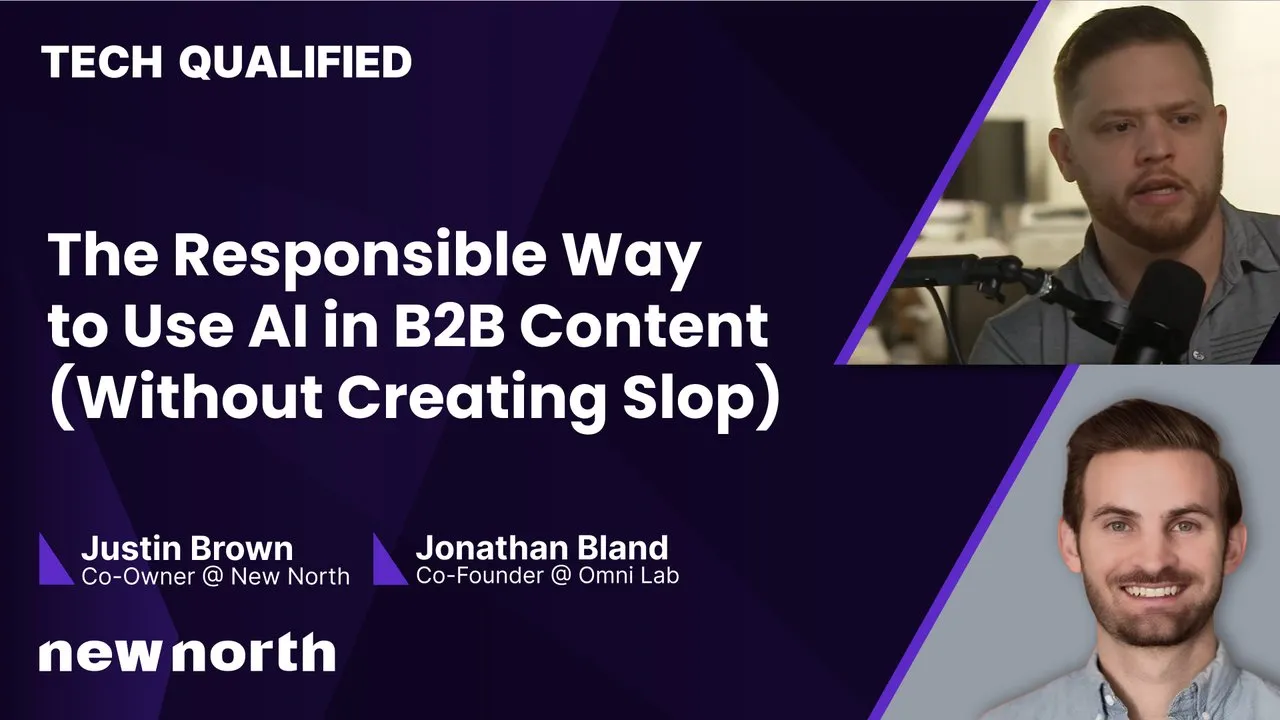
In this episode of Tech Qualified, host Justin Brown sits down with Jonathan Bland, Co-Founder of Omni Lab Consulting, to talk about using AI in B2B content without adding to the slop flooding LinkedIn and the wider web. They open with what scrappy marketing means, including why heads of marketing are walking away from expensive ABM platforms they bought before the basics were in place.
The core of the conversation is the difference between responsible and lazy AI use. Jonathan and Justin agree that AI is not the problem. The problem is content with no source material, no point of view and no proprietary insight. They look at how brands like Ahrefs get it right by pairing heavy AI use with first person writing, real examples and original data.
The episode closes with a real story: how Justin’s business partner Tristan went from no content to a working M&A practice in six months, using AI to scale content drawn from real conversations. AI is a force multiplier, but only when human perspective sits underneath it.
Jonathan runs a demand gen and paid media agency for SaaS brands and shares tactical takes on AI in content and scrappy marketing on LinkedIn.

What Jonathan says about AI content strategy
Big ABM Tech Often Outpaces What Teams Actually Need
Companies are leaving expensive ABM platforms because they bought tech they did not need at prices they cannot justify. For small B2B teams the lesson is sequencing: process and fundamentals first, tools second. Much of the same outcome can come from stitching together affordable tools for outreach, website identification and intent, which is the idea behind Scrappy ABM.
AI Is Not the Problem. Missing POV and Source Material Is.
The useful question is not whether AI was used. It is whether the output carries an original perspective, proprietary data, lived experience or real expertise. Ahrefs is Jonathan’s example of doing it well: first person writing, real product screenshots and clear opinions, all produced with heavy AI involvement.
Repurposing Is Where AI Earns Its Keep
Most B2B companies already produce far more source material than they capture: sales calls, internal meetings, podcast appearances and customer interviews. The win is not more net new content. It is turning what already exists into more formats, where the human perspective is already built in.
Stay Close to the Writing
Even if AI can write everything, leaders still have to show up on calls, podcasts and stages and defend what was published under their name. Outsourcing the thinking erodes that. Writing is part of staying sharp, not just a deliverable.
Jump to the moment
The Scrappy ABM Movement
Jonathan defines scrappy marketing with examples like regional Super Bowl ads and low cost billboard plays, then turns to the ABM platforms teams buy before their process is ready.
Sometimes the big expensive plays or the big expensive ABM products feel cool, and they're very powerful, but oftentimes they're really not needed. And many times we haven't even actually got the process stuff right before we layer on tech.
Why Ahrefs Is the Model for AI Assisted Content
Ahrefs pairs AI with a strong process, its own data and a clear point of view, and the output reads as practical and specific.
They're extremely practical. They always provide examples... And they're huge advocates of AI, and they use a lot of AI in their process.
The AI Slop Problem on LinkedIn
Justin argues that LinkedIn is shaping how people judge AI content, because so much of what gets posted has no perspective behind it.
LinkedIn is one of the biggest slop factories on Earth, and I think it's actually really harming the perception of AI content.
Zero to Pipeline in Six Months
How Tristan built an M&A practice from scratch with AI assisted content rooted in real conversations, including one post that drew 50 responses.
It's all 'AI content,' but it's AI content that's derived from someone who's doing the work, who is out there having these conversations.
Imperfect Content Often Wins
Unpolished posts and lightly produced video often beat perfectly structured pieces.
It almost feels like the unpolished content and the stuff that's less grammatically perfect seems to do better, versus the really perfectly polished, structured piece.
Questions this episode answers
Is it bad to use AI for B2B content?
Where does AI help most in content?
Should founders still write their own content?
Does AI-assisted content actually work?
Does content need to be polished to perform?
Read the full transcript
Jonathan Bland: You can’t get too lazy with it too, and unfortunately, AI has made us all increasingly lazy, just like my GPS has. I don’t even know where I’m at. If my GPS doesn’t tell me, man, I’m lost.
Justin Brown: Hello and welcome to another episode of Tech Qualified. My name is Justin Brown, and this episode is brought to you by New North. New North helps small, scrappy B2B tech marketing teams build real marketing functions through strategy and execution across content, paid, ABM, and reporting. Today, I’m joined by Jonathan Bland, the co-founder of Omni Lab. Jonathan spends his days helping companies optimize paid media performance, but he’s also spending a lot of time thinking about AI content and where marketing is heading, just like we all are. Jonathan, welcome to the show.
Jonathan Bland: Thanks, my friend.
Justin Brown: All right. I’m gonna start this interview like I start every interview. What does scrappy marketing mean to you?
Jonathan Bland: I think ultimately it has a lot of definitions, but for me it means, getting hacky using tools that are cheap and inexpensive that ultimately allow you to get the same job done. It reminds me of what’s been happening over the last year and a half, and I hate to call out a really big ABM platform, but 6sense unfortunately has been on the way down for a lot of heads of marketing that we’ve been talking to, and mostly because it’s a lot of tech that they didn’t ever really need for the price point that they’re paying for. And so I think scrappy means finding other ways to get the same type of result versus the traditional methods.
And so there’s all sorts of ways to do that. For example there was of course Gong’s famous example with the Super Bowl where everyone thought they spent three, four, $5 million on an ad when that really wasn’t the case. They actually did a regional specific advertisement and saved a ton of money. That’s a way of getting scrappy but still having a really big outcome and the cool exposure that you get from a Super Bowl ad. There’s also things you can do with billboards in New York City.
Lots of times people think billboards cost lots of money. They actually don’t. There are some really cool vendors. They cost 500 to a $1,500 where you can literally take a ad or an animated ad and you could run it for a day for that amount of money. And then what you can do is you can get, again, to use the word scrappy, to take pictures of it, repurpose it organically, get further distribution and reach on it, put thought leader ads behind it, all sorts of things.
And so, I think sometimes like the big expensive plays or the big expensive ABM products or just products out there feel cool, and they’re of course very powerful, some of them, but oftentimes they’re really not needed. And many times we haven’t even actually got the actual process stuff right before we layer it on tech. So that’s I guess a little bit about some of the examples that come to mind of being scrappy but still achieving a bigger outcome or effect.
Justin Brown: So, and this isn’t what this episode is about, but it is interesting that you bring up 6sense. For years I, you know, our typical client retainer or budget that they’re putting towards marketing, which is in many cases their entire marketing spend, or it is they have one person or two people in-house and they’re doing a couple of things maybe on paid. And the amount of people over the years who I’ve talked to and that’s their infrastructure and they’re like, “Yeah, we’re looking at 6sense.” And I’m like, “You’re going to put more money into your tech than you’re going to put into actually getting…”
That’s before any work is even getting done. And, we actually, when we started to revamp the way that we do ABM like four to five years ago in a way that is very scrappy, where we would actually piece together, the ABM, these tools like Smartlead or HeyReach, and then have them communicate with each other and use de-anonymization tools like Factors or RB2B. We called it Scrappy ABM. So we’re actually selling against 6sense with what we, it’s not revolutionary to call it Scrappy ABM, but that’s what we were calling it when we would, I would be on sales calls and talking to people and “You could do this the scrappy way, or you could do this basically an enterprise way, and you don’t even have any infrastructure.”
So, or the people who come to us and they’re like, “We bought 6sense. What do we do with it?” So it is very interesting that you bring that one up ‘cause I have seen it firsthand. I’ve seen it on, a lot on LinkedIn people talking about it right now. Which brings me to today’s actual conversation, which is that there’s a lot of discourse right now around AI content. And I can talk a lot about how we leverage, AI within content, but I’m curious from your perspective, what are you seeing right now?
Jonathan Bland: I think there’s definitely your AI spies or the hunters out there that are out there to criticize any content that uses a phrase that’s commonly used or make fun of or criticize content that’s been done with AI. I think it’s less an issue that it was generated with AI and more the quality of the writing and what’s being delivered in it. Because at the end of the day to not use AI at this point, and frankly before that, there was other technologies, there was Google, there was all sorts of ways to do things before LLMs, and so this isn’t like something that’s really that new.
People have been leveraging technology to write, build, and design content for forever, ever since tech has been around in the digital age at least And so for me I guess I have less of an issue with leveraging it. I think the problem I have is I think that if you don’t have some type of human in the loop towards the end of that process to really make sure that not just that it sounds like you, because there’s a lot of things you can do with data stores and creating a brain to make that happen. But I do think that there’s some insights that sometimes need to be layered into it, if not injected into the prompt itself, that express your POV, that have proprietary insights from your product, that partner with SMEs, like all of those things that make the content more original research versus just, “Hey, write me a blog post on demand gen versus lead gen so that I can publish it on my blog.”
And you see a lot of that content that doesn’t really express any POV, doesn’t have any data to back it up doesn’t have snapshots backing up either graphs or anything that’s being talked about. And I’m personally just a huge fan of, when I think of great content, I think of brands like Ahrefs, I think does just an absolutely killer job with their blog. It’s extremely practical. They always provide examples in almost every case. They not just provide examples text-based, but actual snapshots, lots of times playing into their product too.
And they’re also huge advocates of AI, and they use a lot of AI in their process. And they of course, have done this not just in the simple way that I think a lot of people are using AI right now, which is just simple prompting but really creating a true data store and a true process based upon what’s already worked for them before. And so I forget the guy’s name. I don’t know why I’m blanking on it. Maybe you know him, but their head of content over there is just blank.
I can literally see his face right now. But he’s had a great process for creating great content for a long while. And so I think that the hidden unlock for AI and the reason why there’s so much slop is that some people haven’t really unlocked what that process flow, format et cetera, actually looks like. And so it’s just produce me something and produce more of it. And that’s what’s creating just a lot of nonsense out there. But if you have the right process and you’ve done it before, you have the experience to guide AI in the right way, then it can be an incredibly powerful tool.
So I say all that to say yeah, big fan of leveraging it where it needs to be leveraged. I do think though, when you’re writing as a founder, an SME or someone at a company, there is something to staying close to the writing And actually writing and just keeping up the skill of writing. So there’s kind of like different styles of content. There’s like programmatic blog content, there’s just corporate content from your company, there’s you as a creator, you as Justin, you as Tristan, you as whoever.
And I think that type of content really does need you to kinda really sit in the seat a bit more, especially with commenting, DM’ing, like asking questions and stuff like that. You gotta be there for the content. For me, part of it’s like learning, right, from others, and I can’t do that just by outsourcing all of my thought process to an AI. I wanna be there. I wanna ask the right questions. I wanna think about it myself.
I wanna ponder a little bit. And some of that just has to happen by you getting into the trenches and doing it. So I’ll stop there, but a few thoughts.
Justin Brown: Yeah, for sure. I mean, I think there’s a lot of places that, it’s just interesting that you brought up the keeping yourself fresh with writing. This has nothing to do with content, but this is actually just communication. I’m a huge AI content advocate, and we’ll get into that in today’s call and the ways that I think that it leads into my next question, actually, which is being responsible using AI versus not. But I think one of the most irresponsible things that I see is when people communicate, whether it’s via email or it’s via Slack messages, and they answer your questions, and it’s an A, “Thank you so much for asking that question. It was a very thoughtful question that you just asked.”
And I’m like, okay, so I’m not talking to you. I’m not talking to Jonathan. I’m not talking. So, like, when I write emails as an example I really try to only use AI to, maybe I don’t maybe I’ll spew too much in an email and I’m like, “Hey, can you help me truncate this down a little bit?” But, when I get an email from someone and it’s all written via AI, or I ask somebody whether it’s on my team or one of our clients or whomever, and I’m like, “It’s just a quick question,” and I get back an AI-generated response, I’m like, man, some of the, some of just the ability to communicate and staying sharp with the way that you talk to people does feel a little bit lost sometimes.
And, we started this conversation talking about LinkedIn. I think LinkedIn is one of the biggest slop factories on Earth, and I think it’s actually really harming the perception of AI content because you go onto LinkedIn and you just see so much what I would consider irresponsible AI use that I’m like, “This isn’t actual unique perspective. This is just something to be out there.” Or somebody saw someone else write something, and they just wrote some, a piggyback post off of it that probably took them two seconds to write.
So that’s my next question to you is, where do you see the difference between using AI responsibly and then just simply letting AI do the work?
Jonathan Bland: Yeah. You made me think of something earlier that I was thinking about too related to outsourcing content and writing to AI, which is, so often, most of us, at least in B2B, need to show up to a call or a podcast or a live event or talk to a customer or prospective client and actually know what the hell we’re talking about. And so I think it would be one thing if you could just kind of live in the shadows and produce content and never have to engage with the world, and maybe you could get away with that for a while.
But I think the other reason why it’s so important to stay so close to the content is that you ultimately have to show up and likely do calls and conversations and podcasts and live events and you name it. And so it helps to stay really close to the content, understand what you’re writing and/or what is being drafted for you so that you can really speak to some of those things. Because otherwise you’re just gonna end up in a situation where it’s very hard to communicate on, what’s good and what’s bad.
And so much of this too is staying close to it, whether it be LinkedIn. And LinkedIn to your point, yeah, LinkedIn’s really just gone downhill unfortunately, which is a bummer. Hopefully it can come back. But yeah, the slop is just terrible to your point. It really just, yeah.
Justin Brown: And it gives like a negative connotation, I think, to it where that’s what people see the most of, and then it’s just “Oh, we don’t want that.” And, from my perspective, when it comes to responsible versus irresponsible, I have like almost like layers to it. So you mentioned, creating a repository or a brain. So we do that for our clients, and I still… So basically we digest every piece of content that the company has ever created. And we have clients all the time, they’re like, I have clients in freight tech.
I have clients in bio-waste, technology for eliminating bio-waste in a green way from hospitals. I, they’re like, “Can you, or do you have someone on staff who’s an expert in writing on that?” I’m like, “Absolutely not.” I promise you, I do not have someone who’s worked in the freight industry for 15 years that can write you an article on how to fix freight that breaks before it lands, and then when it lands at Costco, getting sent back to the original factory. I do not have that on staff.
And I still don’t even think that even with the repository that the articles that we would be creating would be that good. They could be, and we have a lot. We have the seven sequence prompt that’s checking itself and what have you, and we’ve digested all of your content. We know who your competitors are, et cetera. In these niche technology spaces, you look at this conversation that we’re having right now, I’m gonna turn this into a blog post, and you could have a blog post where I go in and just say, “I want this to be a blog post about content,” AI content, and could type in a million different things, and it’ll produce something.
It’s not going to be my perspective, and then my perspective talking with another agency owner where we have, significant perspective. We live in this stuff all day. I’m not saying necessarily that my perspective is the right one or that yours is the right one, but we have perspective, which helps to build authority, where we are actually putting human element of perspective. So when I’m talking to these clients we want them on camera talking, or, even if it’s just an internal call, talking about their space, because they’re going to have the perspective on their space, and that’s where you can turn that content into a variety of things, not only including, putting out blog material, but also putting out multimedia content that is driving the ability to be found within the large language models of are you appearing on YouTube?
Are you appearing and having perspective on LinkedIn or X or whatever it may be, where you’re putting your, you’re using as an outlet. Because that stuff is going to drive whether or not your organization gets referred. I just got off of a call where, I was talking about one of our clients, and they were mentioned by… They put out an episode for a show that they do through us, and they had a handful of people who put onto LinkedIn that they consumed that episode. They get 100 to 150 downloads, which is what streams, they’re streams, but they’re still called downloads in podcasting.
They get 100 to 150 downloads an episode. They’re not trying to have some entertainment show that’s getting 10,000, 20,000 listens an episode, but they’re getting referenced by people in their space because they’re showing up and they’re doing the hard work, and that stuff can’t be replaced by AI. You can do it, you… Like you said, you could do it for a while. You can put stuff out there. You can have your blog get populated.
You, but to have that real human perspective on the industry that you work and live within every day, it still requires people. I, and I think people don’t… it’s like an all or nothing. It’s like either an organization is unwilling, “We don’t do any AI content here,” or it’s “Just make content work for me.” And I think there’s somewhere in the middle that is reality, which is that you can use, you can use AI to get more, velocity, to be able to do more, to have it take less work but you can’t replace it.
And conversely, I also don’t think that the legacy way of doing things when I’m talking to somebody and that I’m, I say the same thing. I’m like, “Okay, so, let’s say you’re in, some sort of scientific tech,” which we’ve had a handful of clients in that. I’m like, “What are you gonna do? You gonna go pay a scientist three, $4,000 to write you a blog post? It’s probably gonna take them six weeks because they’re worried that any word they put on paper is going to be reflective of the research that they’ve done over the course of their career.”
Same thing with CEOs. We’ve seen that a million times, right? Where you want your CEO to contribute to content. They say they wanna contribute to content, and then it takes them months to get you one article.
Jonathan Bland: So I think you made a good point there. The funny thing about that is they’re already probably creating an immense amount of content already off of all of these recorded transcript calls, right? Think about all the calls that are recorded in many of the conversations they’re having. Now, maybe not all are completely just open air to put out in the public, but there’s lots of little excerpts and things that they’re saying, their POV, their take, the things that are happening, the things they tell their organization internally and externally, they can all be repurposed.
And so as soon as you start to think about that, then there’s just a huge amount of content that’s theoretically being created. We to date have never gotten really good at doing that. But I know Gary Vee obviously is one of the OGs in this, right? Clearly. And he’s not the only one that can do it, clearly. There’s lots of stuff that’s being recorded all the time.
He just happens to record even more and has a huge team behind him to actually repurpose a lot of the stuff that he says in 13 different ways across 13 different platforms. And so CEOs do have the time. They’re already kind of doing the work. They already have the stories. It’s just more about grabbing the recordings, grabbing the transcripts, or having some camera that literally sits there on all day while they talk, and then have a team behind them to go download the thing and use a little bit of AI to, start evolving that.
‘Cause at that point for me, AI on the repurposing front, I don’t mind, I guess, using it a little bit on the front end, but I definitely don’t have any issue with AI on the repurposing front. That almost seems like it’s a 100% AI type of move, aside from maybe, getting the right snapshots and pictures and just kind of doing a final review of some things just to make sure that, the output is ultimately good. But if you’re taking original content, back to your point, from either a long-form YouTube or a long-form podcast it’s, the content’s already there.
So you’re just finding ways to repackage that content in different ways. And so for me, like, all day long go for it. Do those things as anyone should. And frankly, all these tools, and you guys of course are doing it really well need to be investing in this a lot. It’s always been the number one thing, right? We’re always thinking about the next piece of content when we really already have tons of content.
We just haven’t repurposed it and distributed it well. So it’s tough.
Justin Brown: Yeah. And I have a question on here. I’m curious your take on it. Do you think that the future of content is using AI to create more content? Or in kinda what you’re saying, do you see it using AI after you create good source material?
Jonathan Bland: I think you need good source material. You can inject the source material into AI to get better content. And I think there’s kind of two worlds just to say it. Like one, like I’ve been a content creator and a writer for a while now. And so I think I extract some meaning from that, doing the content creation. And so sometimes I have a I’m kind of like in this, world of cognitive dissonance where at one level I’m pro-AI and the other I’m not as for AI because I extract some meaning from doing it myself.
But I don’t know. Back to your question, yeah, original research and creating original source content is always gonna be an element that creates good quality content on the back end. And so whether you inject the original research into Claude or ChatGPT or a prompt chain of all sorts of things that you’re gonna do, you still need good content at the front end. You can have the brain behind it, but again, for at least the types of things I’m seeing, people want personal stories of lived experiences.
They want Justin’s opinion more often than just the company’s opinion. They wanna know what Justin thinks. And that’s why I think having personalities, influencers, SMEs at the company is really important to have someone that has a voice there because they really wanna hear what that person has to say. Even Ahrefs they speak they write a lot in the first person, so they use a lot of I, and there’s people like names and pictures and the use of I, and it just feels I don’t know, it feels like I’m reading something that they actually wrote versus just a blog that has been written either by AI or even by a human that just sounds like they’re kinda speaking into the void a bit, and again, like you can get AI to… that’s an easy thing, right?
Cool. Use the pronoun I. Some of these things are so easy, right? But back to your point, yes, you need the source content at the front end, and you can definitely get AI to get you pretty down close to the road. I still think at least right now it’s really important to still review and read every single line that gets published. I do think that’s important.
I also think it’s important to have the right visuals, and that sometimes requires an SME to put them together. That could be snapshots of your product, a specific report, a specific moment, a billboard you saw, a headline you saw in an article. I still feel like those things are important elements that create more credibility and interest around the piece, certainly for me, versus just like walls of text that AI is really good at. And so again, Ahrefs is just always my example that I go to.
I think they’re probably one of the best in the industry, in my opinion with some of the content they put out. So those are my thoughts. Love to hear yours, though.
Justin Brown: Yeah, for sure. I think it goes into, what started this conversation. So, for the audience, Jonathan and I were having a conversation as agency owners talking about what we’re seeing, and I think it stemmed from you saying that, you’re somewhat anti-AI while we were having an entire conversation about how to create content using AI. And it’s what really spearheaded the, me wanting to bring you on here, is that we feel very similarly about it, and I can even go back to that upfront example I used in email.
When I’m, when I know that I’m talking to a person or you know that you’re reading an article on Ahrefs blog and was this created by a person or was this created to have a blog that populates for search terms that are, keywords for your business that you’re trying to hit? And I think that the LLMs are seeing through that. I think that people see through that instantly. And I think that you can still create content using AI. If I go back to, pretty much anything that I write these days if it’s a bit longer form, I’m thinking about different planning documents that I write and, I was just writing up what we wanna do as our content strategy as an organization and how that’s going to drive, overarching marketing initiatives that we have for net new leads and opportunities as an organization to try to grow.
And I want people to read this plan that I’m writing. And so what I did is I spent a half an hour talking into ChatGPT and then having ChatGPT create this… I actually took it from ChatGPT and then put it into Claude and create this plan. But I read through the plan, and then I sent the plan to my business partner, to our head of client operations who’s gonna help me stand these things up, and I could stand behind it. Like, I know they’re reading it, and they’re, and the feedback I get, I’m asking somebody to read a five-page business document.
If that thing, if I went into Claude and had two sentences and had to create a business plan that’s five to seven pages long, and I ask someone to read that, I think they’re gonna be pissed reading it. Honestly, they’re gonna be like, “Thanks, man. Thanks for the homework. You spent five minutes on this.” Instead, I used these tools to create something that otherwise would have taken me significantly longer, but it captured everything that I was trying to do. I was able to put, what, how much these things are going to cost and how it makes sense and what we’re trying to generate.
And then it has my perspective on the way that we’re going to do it and the approach that we’re going to take and what content we’re going to create, and all of that created into a document that I was actually very proud of. That years ago, I would have been… would have taken me, half a day to create that document. And so I think that there is tremendous value in using AI to enhance the work products that you’re creating. But I think that there is tremendous downside again used it three times, but going back that email thing is like the instant, I don’t know ticked offedness where I spend, five minutes reading something and I’m like I’ve talked to you before.
This is not how you speak. Why are you using the robots to talk to me? We are people. Can we not communicate? And that’s probably why Ahrefs blog stands out to you, and you’re like, “I actually enjoy reading this ‘cause I feel like I’m getting perspective from an industry-leading, not only an industry-leading organization, but from the people within that organization who live and breathe this stuff all day, and I actually feel like I took something away from this rather than it just being more slop that’s out there.”
Jonathan Bland: Again, like real stories like Influ2 is another company I think about. I was actually gonna do a video the other day of these guys, and I think I haven’t read a lot of their content, but there was one blog that just came out and stood out to me, and I need to create a video on it, post it on LinkedIn. But just to give them like a real kudos for it because again, it just comes back to the same thing that we’re talking about related to content.
Again, like the source material is kind of everything, right? And so I think that’s where the slop is coming from. When there’s no like opinion, POV proprietary data, visuals to kind of back up and go with what you’re saying, then I think it starts to fall in that slop category where and it’s easy too, ‘cause like I could create 1,000 blogs on paid media literally right now, and it would take maybe a second to churn out, but by the end of the day, I would have 1,000 blogs.
Justin Brown: Yep.
Jonathan Bland: But my belief though is that like I don’t, I don’t think it’s a volume game that we’re really trying to play. Maybe at some level, but I think at the end of the day, like assuming that, humans are still gonna be reading content, at least in the short term, and of course now we have bots that are reading content now with LLMs that are just reading content and summarizing it for humans. So there’s obviously a good portion of that, and that’s been going on for a while.
But when we’re talking about influencing, B2B buyers that are trying to make decisions, that are trying to trust someone, I still think that the content is really gotta be built for human readership. And I think there’s definitely some folks out there that I’ve been talking to that are seeing both sides of that coin. But at least for me, I don’t know, it just feels better, I suppose, as a content creator and someone, I guess, who derives a little bit of meaning from this to make good content that, to your point, you can stand behind.
And then two, that like someone actually that’s a human wants to read, again, it goes back to the blog article. Like you could write a demand gen versus lead gen article in two seconds and give like a two-sentence POV on the two and have a blog done because demand gen has volume around it, and so does lead gen, and you wanna play that game in terms of just appearing in either LLMs or from an SEO perspective. But I think the real value though is going beyond that and what’s, what was your experience in switching from those two models?
What did you actually do? What did your campaign structure look like, and show me a picture of that. How much did you spend, and how did you allocate budget? Like getting into the weeds of like actually what happened. And again, like you can give the, an AI or LLM the source data to get to that output, but you gotta have the source original data to create good content. So again, I think it’s just I think we’re saying the same thing.
You gotta use AI clearly ‘cause otherwise you’re just gonna fall behind. But you can’t get too lazy with it too, and unfortunately, AI has made us all increasingly lazy, just like my GPS has. I don’t even know where I’m at. If my GPS doesn’t tell me, man, I’m lost.
Justin Brown: I feel so bad for the generation before us, like our fathers and father-in-laws. My father-in-law was like a, he drove up and down the eastern seaboard for the entirety of his career, knows every road to anywhere, and he’s always I’m going somewhere, and he’s telling me, “Oh, you’re gonna turn left here.” And I’m like, “I appreciate it, man. I’m just gonna rely on the lazy side of it.” I wanted to bring, one example. It’s a very selfish example, but it’s something that I’ve gotten to work, that I’ve gotten to see firsthand, which I don’t get to see a lot of these days because majority of our clients come to us and they’ve been… our clients are typically not like high, fast growth SaaS companies.
They’re like profitable businesses that have been around for five to 10 years. They’ve done marketing a certain type of way. It’s done this or that. They’ve tried channels, and some channels have worked and some haven’t. And we’re kind of like rebuilding what they’ve done. But they have historical data, they have historical experience.
What I’ve gotten to see over the last six months is that my business partner, Tristan decided that at the beginning of the year, we were going to start to really do this M&A push where he has stopped working so heavily in the business every day, and he is out there speaking to agency owners about their business and are they interested in selling that business, merging with us, et cetera. And it’s been very fascinating to watch because he went from literally zero content. I, he had done no content ever on this type of work.
We had done three acquisitions in the past, but we did that all… There was no content we were putting out. We were using brokers and firms and just go out there. We had a lead gen firm that was basically bringing us agencies that were for sale, but we weren’t doing anything proactively in the world to do that. And at the beginning of the year, he decided he was going to start posting content on LinkedIn about this. And it is a very small space.
There’s not like a ton of people doing acquisitions of agencies from one to $10 million a year. And I got to watch some… And he uses AI in all of his content. He has a content calendar that’s probably booked out through middle of July, a post on LinkedIn every single day. He’s got a newsletter, a podcast. And his content is getting derived from the real-world experiences that he has.
And I watched one, he put out a post at one point. He’d never done this before. He’s probably like a month and a half, two months into this, and he puts out a post asking, if people out there know any AEO, GEO firms that would be for sale. And the thing got 50 responses because people are like, “This is real. This is different.” This is actually someone who’s doing something interesting, writing about his experiences.
He talks about the deals that he’s in and what’s going on. And hey, if you want a million dollars cash at close for your business, but that business does $2 million a year, any buyer of that business, well, they wanna put their million dollars into a $4 million business. And then he can use that content to send over to them and be like, “Hey, like I wrote a piece on what we were talking about. I wanted to put my thoughts down on paper.” And it’s just been fun to see the new newsletter adds.
Not ads, A-D-S, but like A-D-D-S, like the people who are subscribing to his newsletter. We have a Slack channel set up, and I’m watching new people subscribing to the newsletter. And I got to watch this all happen from zero, and it’s all, I’m using finger quotes for the listeners, like it’s all AI content, but it’s AI content that’s derived from someone who’s doing the work, who is out there having these conversations and who’s leveraging these conversations, whether it’s via podcast or just actual conversations with people he’s talking to.
And I’ve watched one of the most interesting I won’t say impressive ‘cause I’ve seen a lot of different things. We have a podcast that went like nuclear when it came out ‘cause it’s about longevity. It’s not ours, but one of our clients. So I wouldn’t say it’s the most impressive, but it has been the most intriguing because I have gotten to watch it from zero to where it is now, where like people reach out to him every day to have conversations about where their agency is headed and what it’s doing and what’s he seeing.
And you just don’t get that if one day he just decided, “I’m just gonna be this M&A guy and I’m just gonna write about M&A, and I’m not really having these conversations, and it’s not derived from personal experience.” And I think the thing that intrigues people about what it is that we’re doing on that side is because we have someone who’s out there. And that’s what I just run into a lot with our clients, is like they want to be able to turn on the content button and then watch organic leads roll in, and they’re not willing to put the time, energy, and effort into actually having a perspective, a unique point of view.
And I think that if he wasn’t doing those things and he just decided he was going to, put content out there for the sake of content, using AI, I just don’t think that we would have the same sort of experience that we’ve had over six months. So it’s been very interesting to watch kinda a zero to where it is now. And it all comes from real-life experiences, like you’re saying. I just don’t think you can make that stuff up.
Jonathan Bland: No. I think that’s the best part about it. Yeah, again, I think you said it, the source material. That’s what it all comes back to. You gotta have the source material, you gotta have the POV, it’s gotta come from something real or researched, and ultimately that’s the stuff that people wanna read, and I guess whether… I don’t know if anyone really cares.
Everyone I think is hypervigilant on identifying what’s AI and what’s not right now. I think, clearly that’s just gonna go away. I assume everything’s probably had the hand of AI at some level at this point whether one word or the whole thing, I guess what I’m more curious about is what was the learning? What was the story? How can it help me? Because we’re all thinking about ourselves predominantly when we’re reading content.
“This is interesting. How do I relate this to my situation, to my business? How can I personally benefit and be a better person?” In whatever, communication, marketing, business, you name it. And so I’m not sure I really care. Again, there’s some people out there that love to kind of pick on just AI phrasing and things like that.
I don’t know. But for me, doesn’t really make or break it as long as ultimately it’s someone speaking from true experience, and of course there’s gonna be bad actors out there that are just truly just making stuff up. But, you gotta read between the noise and ask the right follow-up questions, and that’s why it’s not just about posting the content. It’s about being active in the communities, like physically and digitally active in the communities, talking with people in DMs, in comments, on their posts, all sorts of other things.
And so I think that’s where it does take some work. And to your point, it’s not just about pushing the content button and then waiting for leads to come in. It’s, literally getting out there and talking with people and pulling people aside in DMs and getting on calls or getting on podcasts like we’re doing right now. So yeah, I don’t think there’s any cheat code unfortunately to it. You can definitely work more efficiently and create content more efficiently, no doubt. And if you’re not a great writer, LLM is, s***, your best friend right now because now you can be a great writer.
You can train it on the best writers in the world. You can inject your tone and POV on top of the greatest writers in the world, and also with your original source data. Although it is interesting to say one last thing and I’ll stop, is that it’s so funny when you think about I don’t know. And again, you can train an AI model to make more mistakes and grammatical errors and stuff like that, but it almost feels like the unpolished content and the stuff that’s less grammatically perfect seems to do better, versus the really perfectly polished, structured piece. And so, again, maybe something to add in the prompt to a degree or just simply like, “Forget this apostrophe.”
Justin Brown: Yeah, or anything. Just little things.
Jonathan Bland: Yeah, I don’t know. Adding the word, like help and putting a bunch of Ps at the end, right? Little things like that just kinda create the feeling of okay, cool, it’s not just this perfectly crafted piece. It’s another reason why video content a lot of times does well when it isn’t so overproduced. It’s not to say there’s not a place for high production video. There is, but there’s also a great place for just underproduced video that seems more authentic and real. Literally I just got my cellphone right here, snap a quick video, done, down the road, post the thing, move on with life.
Justin Brown: So, all right, Jonathan, we’re up on time. Could you tell the audience where they can find you and find Omni Lab?
Jonathan Bland: Easy place is LinkedIn, Jonathan Bland, look me up. And then our website is omnilabconsulting.com, so you can find us there. We do the all things demand gen, paid media for SaaS brands.
Justin Brown: Awesome. Well, Jonathan, appreciate the time today, and audience, we’ll see you next time.
Jonathan Bland: Thanks, man.
Announcer: Thanks for checking out Tech Qualified. This show is brought to you by New North, a marketing agency that helps turn your small, scrappy marketing team into a growth engine. To find out more about New North or check out more episodes of this show, go to newnorth.com/techqualified.