
Most founders decide between an agency and an in-house marketing hire based on gut feel, a bad past experience, or whichever option feels safer this quarter. Very few actually run the numbers.
That’s a problem. The gap between the sticker price of a marketing hire and the real, loaded cost of building an in-house function is usually six figures. And the gap between “we hired an agency” and “the agency is actually producing pipeline” is often even wider.
If you run a 25 to 200 person tech company doing somewhere between $5M and $25M in revenue, this decision will shape your growth for the next two to three years. Let’s walk through what each option actually costs, what each one actually covers, and how to decide without getting burned again.
What In-House Marketing Really Costs
The first mistake founders make is comparing an in-house salary to an agency invoice. That’s not the right comparison. Salary is the smallest line item in a real in-house budget.
Here’s what a two-person internal marketing team actually costs at a growth-stage B2B tech company.
Base compensation
For a functional team, you need two people: a marketing lead who can own strategy, positioning, and reporting, plus a doer who can execute across content, campaigns, and operations.
| Role | Typical Base Salary | Loaded Cost (benefits, taxes, equity) |
|---|---|---|
| Marketing Director or Senior Manager | $130K to $170K | $160K to $210K |
| Marketing Manager or Specialist | $80K to $110K | $100K to $135K |
| Two-person team total | $210K to $280K | $260K to $345K |
Loaded comp runs roughly 1.25x base salary once you include employer taxes, health insurance, 401(k) match, equity, and basic HR overhead. That alone puts you in the $260K to $345K range before anyone writes a single email.
Tools and software
A modern B2B marketing stack is not optional, and it is not cheap.
- Marketing automation (HubSpot, Marketo, or similar): $15K to $40K per year
- CRM seats and sales enablement
- SEO and content tools (Ahrefs, Semrush, Clearscope): $5K to $10K
- Design tools, video, stock, Canva Pro, Figma
- Analytics, attribution, intent data
- LinkedIn Sales Navigator, scheduling, webinar platforms
Realistic annual stack cost for a two-person team: $30K to $60K.
Freelancers and contractors
Two people cannot do everything. They will need help with design, video editing, web development, paid media management, or technical SEO. Most in-house teams end up spending $20K to $75K a year on contractors to fill the gaps.
Founder and executive time
This is the hidden tax nobody budgets for. In the first six to twelve months, your marketing lead will need regular strategy input from you, the CEO, or the head of product. If you spend five hours a week in marketing meetings, reviews, and approvals at a loaded executive rate, that’s real money and real opportunity cost.
The all-in number
Add it up for a two-person in-house team:
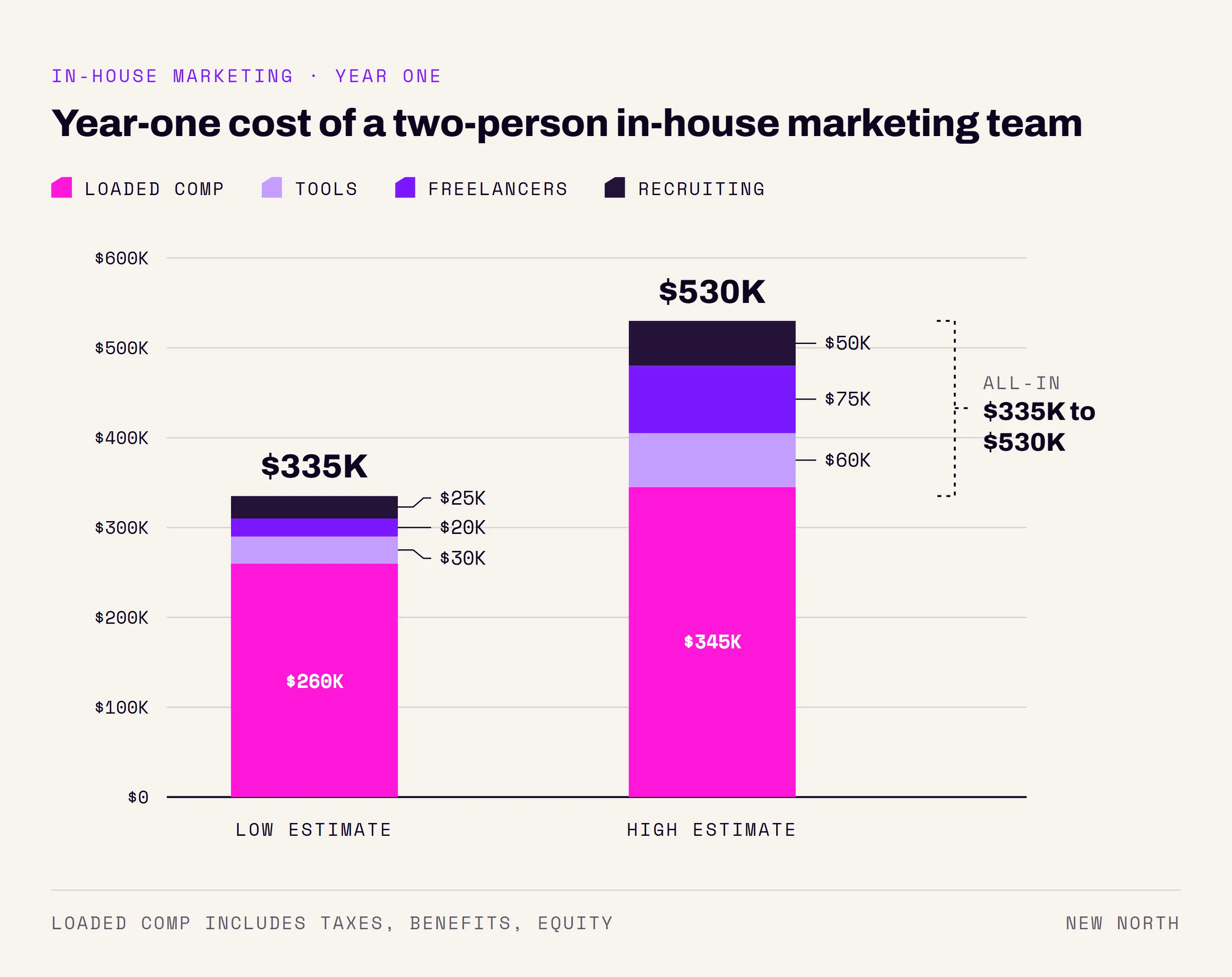
- Loaded comp: $260K to $345K
- Tools: $30K to $60K
- Freelancers: $20K to $75K
- Recruiting fees (if you use an agency to find them): $25K to $50K in year one
- Founder time: harder to quantify, but real
All-in year-one cost: $335K to $530K.
And this assumes both hires work out, stay, and ramp on schedule. Which brings us to the second cost nobody wants to talk about.
The Ramp and Turnover Tax
New marketing hires take three to six months to become productive at a B2B tech company with a complex product. During that window, you’re paying full freight for partial output.
Average tenure for marketing roles at growth-stage companies hovers around 18 to 24 months. If your Marketing Manager leaves at month 20, you’ve spent four to six months ramping them, maybe twelve to fourteen months at full productivity, and now you’re back to recruiting, interviewing, and onboarding. The cycle resets.
This is not a knock on in-house marketers. It’s a structural reality of the role at this company stage. The job is hard, the expectations are high, and the market for good B2B marketers is tight.
What an Agency Partnership Actually Covers
Agencies get a bad reputation, often earned. But a good agency partnership covers things an in-house team of two simply cannot cover at the same depth.
Here’s what a well-run B2B tech agency relationship typically includes. (If you need to make this case to your leadership team, here are seven reasons to share with your CEO.)
Strategy
Positioning, messaging, ICP definition, channel strategy, campaign planning. Not one person’s opinion, but a team that has done this across dozens of comparable companies.
Channel execution
Content, SEO, paid media, lifecycle email, website, ABM, events. A full-stack team with specialists in each channel instead of two generalists stretched across all of them.
Speed to execution
No ramp period. No learning your product from scratch (though they do need to learn your business). No recruiting cycle. Work starts in weeks, not quarters.
Reduced management burden
A good agency manages its own people. You manage one point of contact and provide direction, not daily oversight of a growing team.
Scalability
Need to spin up a product launch campaign? An agency flexes. Need to pull back during a slow quarter? An agency flexes. In-house teams don’t flex. You either have the headcount or you don’t.
What agencies don’t give you
Agencies are not inside your Slack at 9pm. They don’t sit in your product roadmap meetings. They don’t have the same institutional memory an in-house marketer builds over two years. If you need someone deeply embedded in daily company life, no agency replaces that.
Where Agencies Fail (And Why It’s Usually a Shared Problem)
If you’ve been burned by an agency before, there’s a good chance the failure pattern looked like this:
- You hired the agency expecting to get marketing off your plate.
- Onboarding was thorough. Month one produced real output.
- You skipped a strategy call. Then another.
- By month four, the work felt generic.
- You concluded the agency wasn’t any good and started shopping again.
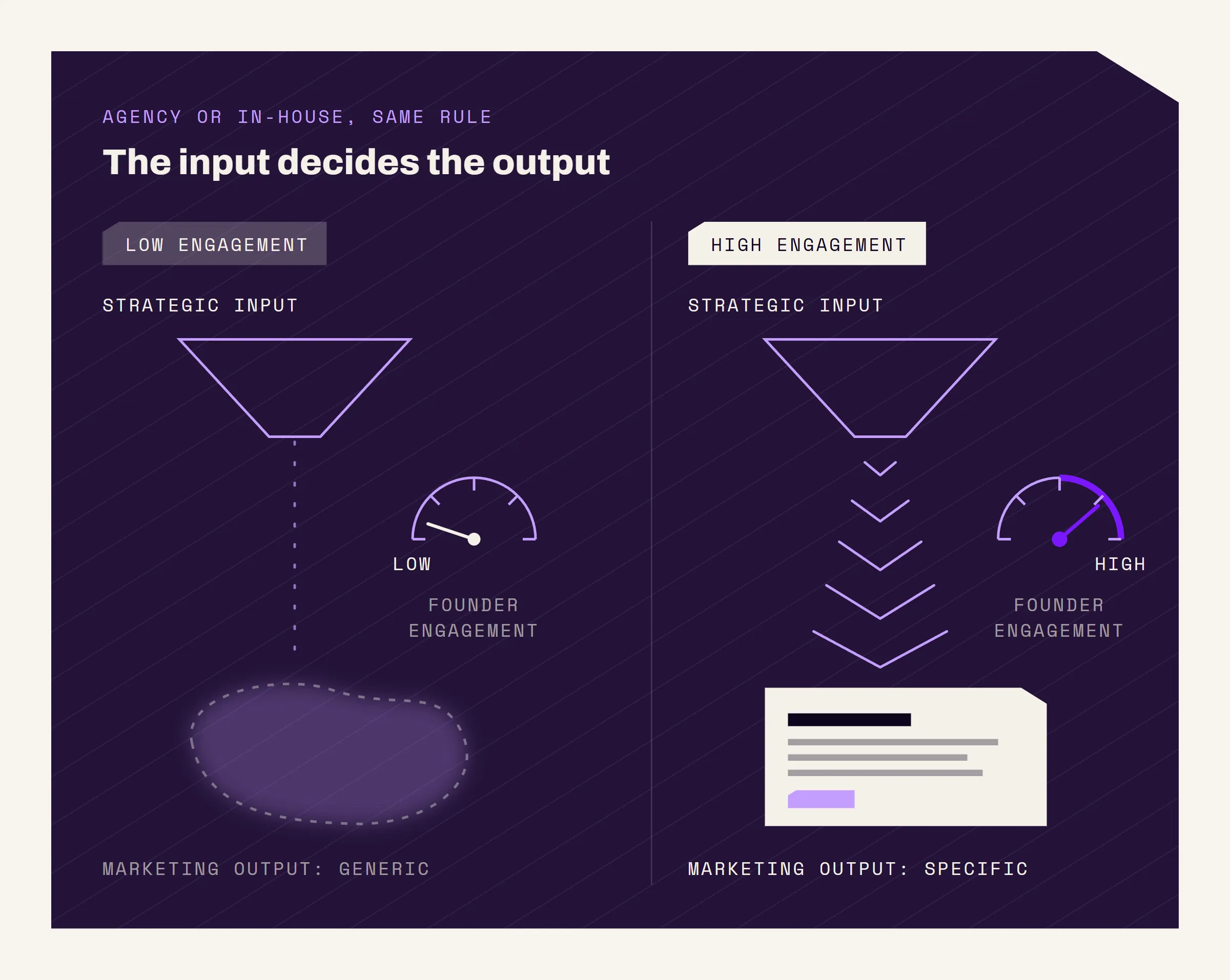
Agencies produce output that reflects the quality of input they get. If the founder or marketing leader disengages, the work drifts toward generic. This is also true, by the way, of in-house hires. A junior marketer with no strategic input produces generic work too. The difference is you can’t fire your employee as easily as you can fire your agency, so the pain shows up differently.
The real variable isn’t who you hire. It’s how involved you stay.
The Hybrid Model: One Internal Marketer Plus an Agency
For most growth-stage B2B tech companies between 25 and 200 employees, the hybrid model is the sweet spot.
Here’s how it works. You hire one internal marketing leader, typically a Director or Senior Manager who can own strategy, serve as the voice of the company, and manage external partners. Then you partner with an agency for execution across channels, specialist skills, and scalable production.
Why this works
- Strategy stays in-house. Your internal leader owns positioning, roadmap, and the relationship with sales and product.
- Execution scales without hiring. You don’t need to recruit a designer, a paid media specialist, a content writer, an SEO lead, and a marketing ops person. The agency covers that.
- Management burden stays reasonable. Your internal marketer manages the agency. You manage your internal marketer.
- You get senior thinking across more channels. A single mid-level in-house hire can’t be senior in content, SEO, paid, lifecycle, and web. An agency team can.
What it costs
- One internal marketing leader, loaded: $160K to $210K
- Tools: $30K to $60K
- Agency partnership: varies by scope
- Freelancer backfill: usually much lower, often zero
The hybrid model typically lands below the fully loaded cost of a two-person internal team, with meaningfully broader coverage. It also reduces single-point-of-failure risk. If your one internal marketer leaves, the agency keeps the engine running during the search.
A Simple Decision Framework by Company Stage
There’s no universal right answer. The right structure depends on where your company is, what you’re trying to accomplish, and how much strategic marketing input you (the founder or CEO) can provide.
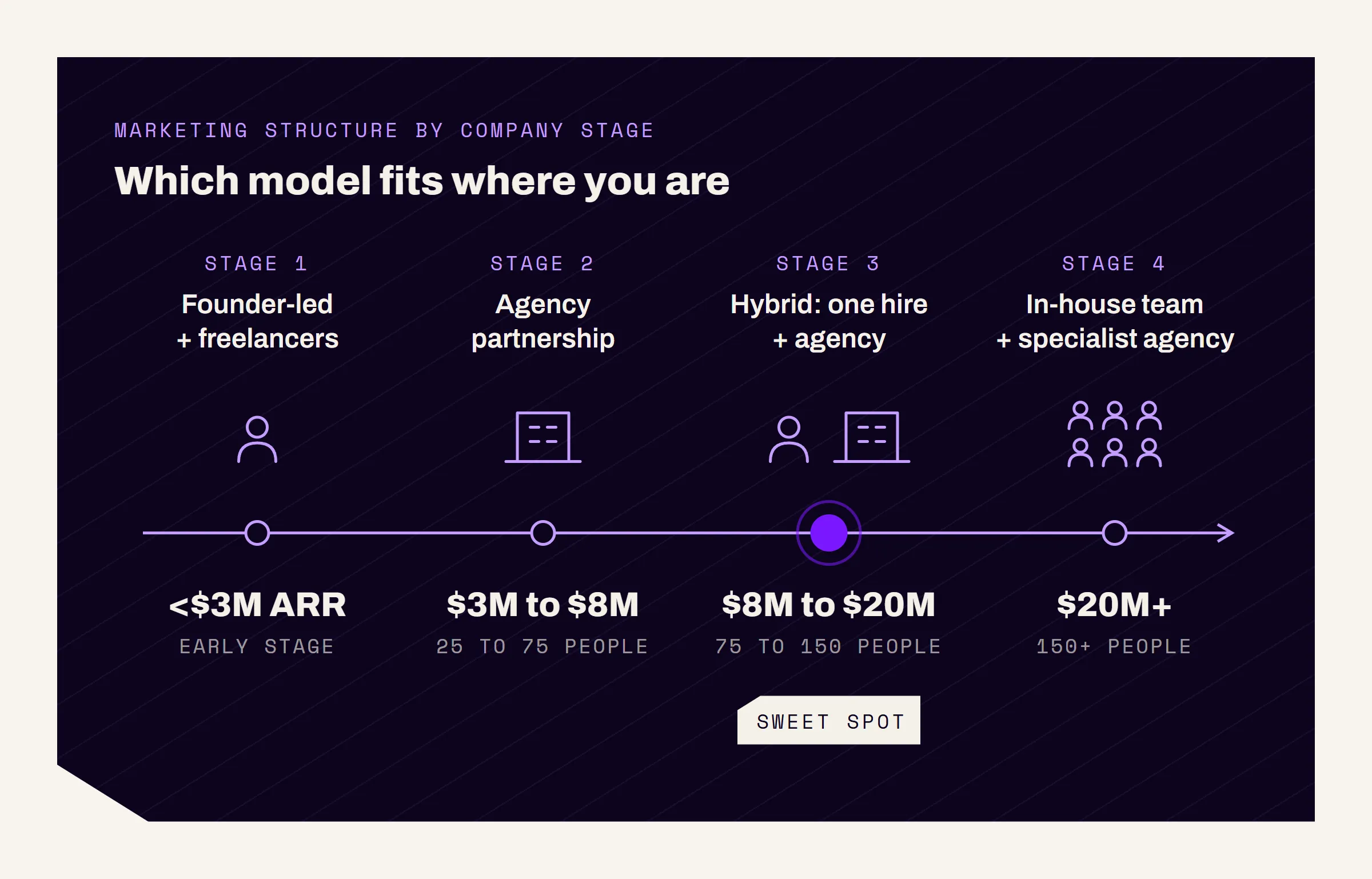
Stage 1: Pre-revenue to roughly $3M ARR
Recommended: Founder-led marketing plus specialist freelancers or a fractional CMO.
At this stage, product-market fit is still being figured out. Marketing strategy changes month to month. The founder needs to be close enough to messaging and positioning that an agency or employee can’t yet add value without constant redirection. Spend as little as possible on marketing infrastructure. Focus on learning.
Stage 2: Roughly $3M to $8M ARR, 25 to 75 employees
Recommended: Agency partnership, no in-house marketing hire yet.
You have enough signal to invest in marketing, but not enough stability to justify two full-time hires. A B2B tech marketing agency gives you access to senior strategic thinking plus execution across channels without the ramp risk of a new hire. The founder or a product leader can be the internal marketing voice during this stage. Expect to spend five to eight hours a week engaged with the agency.
Stage 3: Roughly $8M to $20M ARR, 75 to 150 employees
Recommended: Hybrid. One internal marketing leader plus an agency.
This is the sweet spot for the hybrid model. You need someone internal who owns the function, sits on the leadership team, and can be deeply embedded in sales and product. But a single hire can’t execute across every channel you now need. The agency provides the execution team and specialist expertise.
Stage 4: $20M+ ARR, 150+ employees
Recommended: Build in-house, keep an agency for specialist work.
At this scale, you can justify a team of four to eight marketers. Build the function in-house. Keep an agency relationship for specialist areas (ABM, demand gen campaigns, website rebuilds, SEO) where depth matters more than headcount.
Side-by-Side: The Trade-offs
| Factor | Two-Person In-House | Agency Partnership | Hybrid (1 Internal + Agency) |
|---|---|---|---|
| Strategic depth | Depends on seniority of hires | Senior strategists across channels | Internal owner plus senior external input |
| Execution breadth | Limited to two people’s skills | Broad across channels | Broadest coverage |
| Speed to start | 3 to 6 months to full productivity | Weeks | Weeks (agency) plus hiring timeline (internal) |
| Management burden | High (people management, HR, reviews) | Low to moderate | Moderate (one hire plus one vendor) |
| Flexibility | Low (fixed headcount) | High (scale up or down) | High |
| Turnover risk | High (single points of failure) | Low (agency absorbs it) | Low |
| Institutional memory | High over time | Moderate | High |
| Year 1 total cost | $335K to $530K+ | Varies by scope | Typically below two-person in-house, broader coverage |
What to Watch For, Whichever Path You Pick
Three things determine success more than the model you choose.
1. Founder or CEO engagement in year one. If you’re not willing to spend a few hours every week on marketing strategy, positioning, and review in the first year, neither an agency nor a hire will produce great work. The input quality determines the output quality.
2. Clear ownership of pipeline accountability. Decide upfront who is accountable for pipeline. If it’s the agency, define the metrics and reporting cadence. If it’s the internal hire, give them the authority and budget to actually move those numbers. Fuzzy accountability is the single biggest predictor of a bad outcome.
3. A 90-day review built into the engagement. Whether you hire a person or an agency, agree in advance on what success looks like at 90 days, 180 days, and 12 months. Review candidly against those milestones. Course-correct early.
The Bottom Line
The in-house versus agency debate is usually framed as a cost question. It’s actually a structure question.
A two-person in-house team costs $335K to $530K all-in during year one. That’s not wrong or bad. For some companies at the right stage, it’s exactly right. For most 25 to 200 person B2B tech companies, though, a hybrid structure (one strong internal marketing leader plus an agency partner for execution) delivers more coverage, more flexibility, and less single-point-of-failure risk.
The worst outcome isn’t picking the wrong model. It’s picking any model without a clear strategy, clear accountability, and clear founder engagement. That’s what causes the bad agency experiences and the bad hires alike.
Talk It Through Before You Commit
If you’re weighing this decision right now, schedule a call with us. We’ll talk through where your company is, what you need marketing to do over the next year, and which structure fits: building in-house, partnering with an agency, or going hybrid.
You’ll make the next decision with a clearer picture instead of gut feel.