Engage target accounts long before they start buying. By the time an account is in market, it is usually predisposed to the top three vendors on its shortlist. Praveen Das recommends watching two kinds of intent signals together, situational signals like hiring a new SDR team or launching a new product and engagement signals like third-party intent and website visits, and reaching out when both show up for the same account.
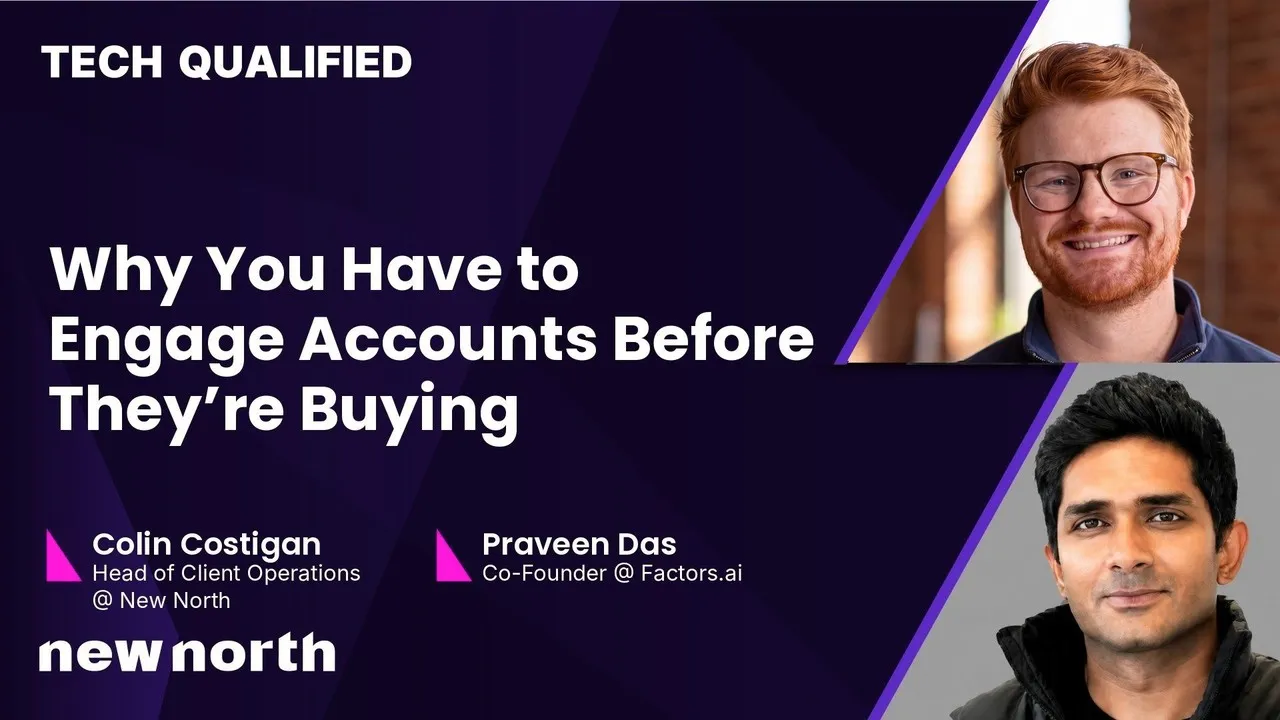
In this episode of Tech Qualified, host Colin Costigan sits down with Praveen Das, Co-Founder of Factors.ai, to unpack how B2B teams turn anonymous website traffic and scattered buying signals into real pipeline. Drawing on nearly a decade at InMobi, Praveen explains why B2B marketing has trailed B2C on innovation, and why that gap is an opening for lean teams willing to work differently.
The conversation moves from ABM strategy to the mechanics of account intelligence: spotting accounts likely to be in market in the next six to twenty four months, why sellers who wait for the 5% in market have usually already lost, and why LinkedIn lead gen ads have become a crutch many teams cannot escape. Praveen also covers partnerships, and why patience is the multiplier most founders underestimate.
It closes with a grounded look at AI in go to market: what an agent actually is, the kinds of agents worth building, and why a conversational layer is likely to replace the dashboard for most B2B software.
Praveen spent nearly a decade at InMobi leading its customer data platform before co-founding Factors.ai, an account intelligence platform used by 500+ B2B teams.

What Praveen says about intent signals
The 5% In Market Are Already Shortlisting
By the time an account enters active evaluation, it usually has three vendors in mind. Unless you lead your category, you are probably not one of them. The real work happens months earlier, while accounts sit in the 95% that are not buying yet. That makes brand awareness the cost of being considered at all.
Track Situational Signals, Not Just Engagement
Praveen separates signals that a company is about to have a problem (hiring an SDR team, a product launch, a funding round) from signals that it is researching solutions (intent data, website visits, review site activity). The best time to reach out is when both are true for the same account. Most teams only watch engagement, so they show up at the same moment as every competitor.
LinkedIn Lead Gen Has Become a Crutch
Some teams spend $200,000 a month on LinkedIn and put all of it into gated downloads. Asked whether that strategy will help them win, most say no, but leadership only funds what shows up as a lead. That is a leadership problem, not a marketing one.
Partnerships Pay Off in 18 to 24 Months
Technology integrations, referral partners and co-sell partners all compound slowly. Many early companies quit before they work. For founders choosing where to spend scarce time, partnerships look like nothing for a year and then become one of the most durable engines in the business.
An AI Agent Has a Goal, Tools and a Feedback Loop
Praveen’s working definition cuts through the hype: a specific goal, access to tools to reach it, and a way to learn from each run. As buyers get used to conversational AI, dashboard and filter interfaces will start to feel dated.
Jump to the moment
Scrappy Marketing Is Product Sprints Applied to Campaigns
Product teams ship in short sprints and iterate on feedback. Most marketing initiatives could be tested in a week if teams lowered the bar for the first version.
Scrappy marketing would be speed over perfection. Launch fast, learn fast, test very quickly, rather than wait for a fully polished, very well planned campaign.
Why B2B Trails B2C, and Why That Is the Opportunity
B2B marketing was, and still is, like a few years behind B2C in terms of innovation. But at the same time, it was much more complex than B2C.
Situational Signals Plus Engagement Signals
A company hiring an EMEA SDR team is an early sign it will soon need account intelligence. Pair that with engagement and the timing becomes clear.
If an account exhibits both of these characteristics, you can assess that they're likely to have this business problem, then they're also engaging with you, that is the best time to kind of reach out.
The $200K a Month LinkedIn Trap
When I speak to these marketers to say, 'Do you really believe this is the strategy that will help you win?' They're like, 'We know this is not ideal, but our hands are tied. We need to get leads.'
Defining an AI Agent Without the Hype
The simplest definition of an agent is that it has a specific goal, it has access to certain tools to execute on that goal, and it also learns after every execution to improve itself.
Questions this episode answers
What are intent signals in B2B marketing?
When is the best time to reach out to a target account?
Why is LinkedIn lead gen a trap for B2B teams?
What is an AI agent, in plain terms?
Read the full transcript
Praveen Das: I am still shocked that there are some of my customers who are spending $200,000 a month, but all they can do on LinkedIn is like lead gen ads.
Colin Costigan: Hello and welcome to another episode of Tech Qualified. My name is Colin Costigan and this episode is brought to you by New North. New North helps small scrappy B2B tech marketing teams build real marketing functions through strategy and execution across content, ABM, paid and reporting. Today I am joined by Praveen Das. Praveen is the co-founder of Factors.ai, an account intelligence analytics platform that helps B2B marketing and sales teams turn anonymous website traffic into pipeline.
Before starting Factors, Praveen spent nearly a decade at InMobi, where he led customer data platform and built a deep fluency in adtech, martech, and large-scale data systems. That background combined with earlier stints in investment banking and consulting gave him a pretty rare vantage point. He understood what the data could tell you and he understood why most teams were completely failing to act on it. Factors.ai launched in 2020 and now serves over 500 clients worldwide.
And I’ll be honest, we use Factors at Marketers in Demand and it’s become one of those tools where once you see the data it surfaces, you can’t unsee it. The ability to deanonymize website traffic, tie it back to your CRM, and actually tell a story behind the numbers is something our team leans on regularly. Welcome to the show, Praveen.
Praveen Das: Hey, Colin. Thanks a lot for having me and really excited to do this together.
Colin Costigan: I am as well. You know, we’re always exploring our partnership together between Factors and Marketers in Demand and seeing how we can always help our clients. And like I said, we’re small and scrappy. So I’d like to start out by asking what does scrappy marketing mean to you?
Praveen Das: Oh yeah, just by the way of introduction. So I’m one of the co-founders of Factors and interestingly I take care of product, marketing and customer success. So three distinct functions at Factors. And the reason I mentioned that is so the way product teams operate, right? So product teams typically operate in short sort of sprints. Any idea they have, they very quickly try to validate it and they put out a POC, try to see how much excitement can you generate, and then very quickly experiment and iterate on ideas, right?
So I, in my view, like there’s a lot that we can imbibe from that entire culture of agile principles in marketing as well. And it’s been a trend for a while, but I don’t think it’s something that is institutionalized within marketing as a function. So in my view scrappy marketing would be like speed over perfection, launch fast, learn fast, test very quickly, rather than wait for, you know, a fully polished, very well-planned sort of a campaign. Obviously there are places where you have to do that, like if you’re doing a annual event, like your big annual event of the year, obviously you want it to be perfect. But for a lot of things in marketing I believe that the bar can actually be lowered for you to kind of test fast.
But I do feel that in many cases marketing teams really want to push the boundary, but that also makes them constrained in terms of speed. So for me scrappy marketing is that, right? So in any initiative, any endeavor, what can you literally do in like one week or two weeks? Can you put something out there? Can you start getting feedback? Like even if it is a website revamp, what can you do in a week, put out there, get feedback from people and then iterate, rather than wait for three months of effort and then one big bang launch, right? So that’s what I would call scrappy marketing. Then that methodology being applied to every facet of marketing that you’re doing, be it demand gen, product marketing, content and so on.
Colin Costigan: Yeah, I couldn’t agree more. I think scrappy and agile are definitely synonymous in marketing. You know, whether you have a large team that you’re working with and you have different departments where everyone kind of needs to get their job done, or you have the CEO working directly with one marketing rep in-house, you need to be able to spin things up quickly. Because if you’re just spending time in the lab and never launching a campaign, you’re never going to have real data. It’s always going to be what could have been instead of here’s what we did and here’s the data we collected.
Praveen Das: Yeah. And I think that entire idea of what have you shipped last week, what have you shipped in the last sprint, whether it’s a week or two weeks, I think that’s a very good approach in general for most teams. And, you know, engineering product teams, they are building products which take six months or a year to build, but they still track everything like sprint-wise and they have daily standups and everything, right? So as I said, I’m not saying it’s directly applicable to everything that marketing does, but I would wager that, you know, there is a lot to be inspired from. Yeah.
Colin Costigan: Yeah. Absolutely. Well, Praveen, let’s take a step back and start at the beginning. So, you spent nearly a decade at InMobi leading the customer data platform. So, that’s a pretty deep seat inside one of the biggest ad tech companies in the world. And you actually co-founded Factors alongside Aravind and Sri, and you also met them at InMobi. So, I wanted to ask you kind of two questions in one. What do you see from that vantage point that made you say there’s a company to build here, and what was the founding dynamic like coming in as a team that all knew each other from the same place?
Praveen Das: Yeah. So, InMobi, as you mentioned, is a very large adtech company based out of Bangalore, and InMobi is primarily focused on the B2C marketing space. So their biggest customers are your Unilevers and so on and so forth, right? And I saw that evolution of B2C marketing for, as you said, over a decade, where you saw that initially, and it was operating at the intersection of mobile and mobile advertising. So mobile was also kind of growing very fast, right, and you could see a lot of innovation in B2C marketing across campaign targeting, media innovation, advanced measurement.
Even now if you look at the ad formats that B2C companies use, you know, they are like, you know, years ahead of what a B2B company would do, right? Like be it, you know, extremely sort of interactive sort of ads that you can see. So I saw that evolution, and B2B marketing on the other hand was, and it’s and still is, like a few years behind B2C in terms of innovation. But at the same time it was much more complex than B2C, right? Like most B2C marketing, it is, it’s very easy to figure out the ROI, because almost always a transaction happens very very close to the ad exposure, and also you are advertising to the person who makes the decision, right?
So B2B was much more complex, but I felt that it was, you know, there was a lot that we could transfer over from the learnings that we had at B2C. So our idea was always to build a modern marketing platform for B2B, and we just happened to start with measurement as the wedge, right? I met my co-founder Sri Krishna at InMobi. So not both Sri and Aravind did not work at InMobi. So Sri Krishna worked at InMobi and we worked together for over seven years there, and Sri and Aravind were batchmates from undergrad, and that’s how the three of us came together. So yeah, and we also brought in complementary skill sets across sales, technology and product, right? So that was the sort of origin story of Factors.
Colin Costigan: Yeah, that’s amazing. It’s great to have a core group of team members and then bolt on the additional skill sets that you don’t have, because again, you know, everyone has their strong suit. We actually take a very similar approach at Marketers in Demand. So New North is just one of the agencies that belongs to Marketers in Demand. We own four agencies, and so whenever we see an opening in the market for something that we don’t have expertise in, we’re actually looking to go into mergers and acquisitions and buy another agency with that service line specialization. So very similar approach. We like working with like-minded individuals and then bringing in the specialist as needed.
Praveen Das: Yeah. I think having a complementary skill sets, and I think having three founders, I believe it really helps, because you’re not prone to like very sort of impulsive sort of decision-making. There’s always some balance, push and pull, trade-offs that you have to make. And especially if you’ve known each other for a while and it’s not that you’ve just met now and decided to start a company, then I think you have that level of trust, which obviously is important because it is a stressful experience, right, like running a startup. So there are good days and then there are very bad days. So you need to have that level of trust to kind of make it work. So yeah, I was grateful that during my time at InMobi I was able to meet with Sri and build that level of trust and then get started.
Colin Costigan: That’s amazing. Yeah. And Factors launched in 2020, which is a year for the recent history books. The same year that the world shut down and every B2B marketer was dealing with zero in-person events and completely changed pipeline. Did that timing help you or hurt you or just make everything weirder overall?
Praveen Das: Yeah, so that timing really didn’t help us actually. So I left InMobi in Jan 2020, and then by March we were just stuck at home, right? And I was like, okay, really not a good idea. Like not what you expected, right? Like when you start a company, you’re like very excited about what you’re going to do, and then you’re just stuck at home. You’re not able to go out and meet people, and obviously there are other sort of more pressing concerns at that time in terms of family, relatives and so on. So there’s not a great time to kind of start up.
Also, I think we kind of started at the early phase, right? Like so nine months or maybe a year after is when the COVID-led investment boom in SaaS happened. If you remember the time when everyone was investing into virtual events and all of those sort of solutions. So we actually started before that, so we didn’t get to ride the SaaS wave during COVID. And I think the timing also caused significant difficulty in terms of just customer discovery, product iteration, right? So at the earlier stages, very important to have like deep sit-down conversations with users, which is just not possible in 2020, right? Like, so, and I still believe that all said and done, virtual has its own limitations.
Colin Costigan: Yeah, I agree with that. And it’s, you know, like we were talking about a bit earlier with the just differences in B2C and B2B marketing. It requires a whole different landscape. You have to think about it completely differently. And, you know, whether it is events or some other form of marketing, whether it’s paid, ABM or anything, it takes understanding the personas, and there’s often going to be multiple personas that you are trying to put the right message in front of, versus B2C when it’s a bit more transactional and you can kind of see that quicker return on investment.
So yeah, totally agree. With all that said, I do want to start talking about like the playbook. Not giving away any of the secret sauce that we use with Factors, but, you know, before we get into tactics, I want to level set for anyone who’s newer in the space. So if someone’s listening right now and they’ve never used an AI ABM tool before, how do you explain what Factors does in plain language? What’s actually happening under the hood?
Praveen Das: Yeah. Yeah. So typically the way I explain it is, like if you look at all your prospects who are buying your solutions, right? So the, if you think about that typical journey, prospects realize that they have a problem and then they start looking for a solution, right? Obviously marketing can kind of play a role in influencing the prospect to say, hey, the problem is very significant, you should actually be solving this, the cost of inaction is very high. But at the end of the day the prospect has to decide for themselves that the amongst the many issues that I face, this problem is significant enough for me to go and fight for budget and implementation and solve that problem.
Now there are sort of signals about a business that indicate that this account is likely to kind of face this problem. Now, like for example, if you’re, for a product category like Factors, one signal could be that, let’s say this company just set up like a new SDR team targeted at EMEA and hired like ten people for it, right? Now that is the starting point of a journey where they will realize that, okay, you need to kind of give enough leads to those SDRs for, they need to have accounts to work, they need to do territory planning, you need to do all of that, and you need a solution for that, right?
So a signal here to which indicates that the business is likely to face that problem in future is probably, let’s say, hiring signals. And there are many others, such as, you know, what you can uncover from press releases, public statements of, you know, the leadership team in that company. Maybe they launched a completely new product, so you can understand that they’re scaling up on that. So all of those indicate what is going on in a business because of which they are likely to be a good candidate for you to have a conversation with.
The second level is once the prospects realize that, okay, I do need to kind of solve this problem, and then they start looking for a solution, that is when you can start capturing some engagement signals. These could be general third-party intent from the wider web. It could be on your own properties, if someone is actually kind of browsing through, you can capture those signals as well, right? Now from a seller’s perspective, if an account exhibits both of these characteristics, which is you can assess that they have, they’re likely to have this business problem, then they’re also engaging with you, that is the best time to kind of reach out.
And then you need to know who owns this problem, who are the key stakeholders that I should be reaching out to. Like for example, if someone wants to sell a customer success software to Factors, probably they should know that amongst the founders I’m the one who’s looking at customer success and, you know, maybe reach out to me, right? But then figuring that out is not very straightforward, especially as you go to very large enterprise orgs, right? Like, so imagine trying to sell something to like a PepsiCo or a Walmart or something like that. And the last thing is once you identify who are the right people, you need to, you need a very good entry point. Like how do you start a conversation in a very non-salesy way, right?
And so this is the overall sort of process, and what we help is we help vendors or sellers capture all of this data and then figure out the best way to kind of engage their account. So we unify all of this sort of messy signals, website, CRM, LinkedIn, G2, news, social signals, into one platform. And then we help you answer this core question of which accounts are most likely to work with you in the next six months, and which accounts are likely to face this problem in the next 24 months, because of which you should actually be building your brand awareness with them right now, right? So I’d say that is a crux of what we solve. And I think of ourselves as, in that journey of helping you generate more meetings, pipeline, etc., we’d be like a valuable addition to kind of make that process easier.
Colin Costigan: Yeah. I mean, I’m sure many of our listeners and you and me both, you know, over the years, we’ve done a lot of manual research, manual staying on top of basically what we can now gather as signals using tools like Factors. You know, again, you alluded to the job changes or a job posting. Even reviewing someone’s post on their own personal profile or their company page. Maybe it’s a press release that’s alluding to a round of funding that’s being secured. There are all these signals that are really going to impact the message, and make sure that we’re reaching out to the right person.
Because as you said, if it’s a, if your ICP is, you know, enterprise sales and you’re trying to sell something that’s 100 or $200,000 a year to subscribe to, there’s probably going to be 10 to 30 people with the exact title that you need to reach out to in procurement or VP of sales, you know, whatever it may be. And so you need to really have your research buttoned up. And I always like having the human layer on top of AI. It’s kind of what I think is a superpower in today’s world, versus just, yeah, I’m just going to turn AI on and let it go, because then there’s going to be mistakes. I mean, it’s not perfect. It’s generative. And you need that human oversight is really what we allude to there.
Praveen Das: Yeah, I completely agree. I am not in favor of the spam cannon approach of saying we’ll burn through like a thousand domains like a month and send out like 50,000 emails per day and so on and so forth. I can’t see how that is like a winning strategy. But then, I mean, there could be businesses where that works, right, and where probably the only option is to kind of do that, because you have to operate at scale.
But for majority of our customers, they are operating with maybe like a 10,000 TAM or like a 20,000, not like the full TAM but the focus list that they’re reaching out to, right? And given the ACV of their products, typically they are much more intentional about how they portray their brand when they reach out to someone. And the moment you keep a higher bar for that, you realize that human in the loop is inevitable because, let’s face it, as you said, it’s generative. It could get things wrong, and they’re not completely sort of debilitating kind of moves, but then it may not kind of portray your brand in the best possible way.
Colin Costigan: Absolutely. Yeah, I couldn’t agree more. There’s a stat that gets thrown around, and it’s definitely more anecdotal than empirical, but something like 95% of website traffic never actually fills out a form, and your whole product is basically built on that gap. So when marketers see that number applied to their own site, what’s the typical reaction, and is that reality?
Praveen Das: Yeah. So I think my sense is that even the 95% is like, so obviously it’s an anecdote, and, but the underlying concept remains the same, that whilst you might have a large TAM of like 5,000 accounts, not all 5,000 are going to be buying or in market for your category of product within, let’s say, a year even, right? So whether it’s 95/5, 90/10, I think the concept kind of remains the same. Because ultimately, as we discussed earlier, sellers can try to educate the buyers about the cost of inaction and the real cost of not solving this problem. But the main issue is that buyers have so many issues to fix, this may not still be like a priority for them, right? So at some point it will, and, you know, once buyers realize that, that is when they get into this 5% bucket of, okay, let me actually try to find a solution for this.
What I speak to customers about is, even in that nuance of, let’s say there’s 5% of the buyers who are in market right now, the key challenge is that they, unless you are the most dominant vendor in that category, right, like unless you are Gong in the call intelligence or solution space, you may still not be in the consideration set, right? So in, there are some markets where there is a dominant player, and the dominant player will always be part of the consideration set, but all the others may not even be in the consideration set, right? So most buyers, when they reach that purchase phase, they already have certain vendors in mind. And I think there is research which says that they don’t go beyond the top three in their short list, right, or they’re already predisposed towards the top three. So they might speak to you, but in their mind they’ve already kind of ruled you out and made a decision.
So the interesting part is, even to win in the 5% you have to actually operate and engage with these accounts when they are not in the buying phase, when they are part of the 95%, right? Because by the time they are in active evaluation, it’s probably a bit too late. And again, it’s not something that I think would scale over time to say I’ll just kind of operate, you know, to capture that demand when they come into the 5%.
Colin Costigan: Yeah, I couldn’t agree more. And whether someone is operating, I mean, there’s so many different types of funnels when you ask a marketer, right? There’s a which is a pretty positive one, and there’s a million others. But I think something that is commonly missed or skipped nowadays is building that brand awareness. I think VP of sales or CEO is so hungry to just turn marketing on and start seeing the leads coming in and then sales numbers go up, that they’re skipping so many crucial steps. And like you said, they’re just going to lose to their competitors who have this brand awareness that they’ve built over a time. They’ve told their brand story. And so you’re just going to lose out on opportunity by trying to skip steps.
Praveen Das: Yeah. I mean, so we work with a lot of customers who are, you know, heavy spenders on LinkedIn. So our product helps you with running better ads on LinkedIn and driving more ROI. I am still shocked that there are some of my customers who are spending $200,000 a month, but all they can do on LinkedIn is like lead gen ads. I believe lead gen ads has a place for sure, but you can’t be spending your entire budget on just like a content download asset, right? Like there is so much more interesting stuff to do on LinkedIn in terms of video, thought leader ads, even memes, something funny, trying to stand out, as compared to like, hey, I have this asset and you can download it.
And when I speak to these marketers to say, do you really believe this is the strategy that will help you win? They’re like, we know this is not ideal, but our hands are tied. We need to get leads. Like, you know, we, the only way we can get budget is if we can show that we’re getting leads on the other side. So, that is really a problem, and it works extremely counterproductively, especially when you’re looking at building that brand awareness. Again, I’d say it’s okay if you are the dominant player in the market. You’re probably going to be there in every RFP, but it’s absolutely not okay for everybody else.
Colin Costigan: Yes. Yes. Yes. Please, can we preach that to everyone? Because oftentimes what I find is the CEO or the VP that wants to skip that process, they’re going to come back six months later with a huge hole in their pocket, everything that they’ve burned running ads, and they’re going to say, “Okay, I guess you were right. This is, you know, we should have poured the foundation before kind of building everything on top of it.”
Praveen Das: Yeah. I think if, to those CEOs or CRO, I think one thing to do would be to just give a sense of market awareness, right? Like how many people in the market are aware about your product, and then figure out if it’s more important to solve that problem than actually get another 200 leads this month, right? So, I think that would be like one way to kind of put that question out. But yeah, it is a tough one, because I think a lot of digital marketers grew up on Google, and the system was you spend money, you get leads, right? And I think it’s very hard to kind of break out of that mode of thinking. But I think the companies that are winning it big are the ones which are able to think differently on that.
Colin Costigan: Yeah. Got to teach an old dog new tricks, right? Well, I want to jump into partnerships and focus on that. You know, so shifting there, I think this is a big part of the Factors story that doesn’t really get talked about enough. So how did you start thinking about the partner ecosystem? Was that an early decision that you made deliberately, or did it emerge from the market kind of pulling you in that direction?
Praveen Das: Yeah, so I think some of our experience at InMobi really helped here. So InMobi also had a lot of agency partners. In fact, in B2C that’s a very well-established sort of system, right? Like you have the big four agencies which, you know, almost all the sort of brand investments happen through those big four agencies. So partnerships was a very big part of how business was done at InMobi, and not just with agencies but technology partners. For example, you know, measuring ad fraud, viewability, all of those, right? Like there was a very large partner ecosystem, and one of the interesting things about programmatic advertising is there are so many sort of players doing, like, you know, solving individual parts of the puzzle, and you need to kind of work with all of them to scale up.
So that ethos around ecosystem and partnerships has, was always there, and so we were always big believers in that. But for us it was different, because obviously we are a much smaller company when we started, and we were looking at partnerships as a way to grow as well, right? So I’ll be honest, it was not just that we were contributing to the ecosystem, we were looking to kind of grow. And for that, when you are a small company, you need to have a lot of patience, right? And as you said, at an early stage, for most founders you’re looking at what can get me that revenue number for next month.
But like a partnership-related investment is probably going to give you results over 18 to 24 months. So for us, I think the conviction that we had that partnerships would help us in the long term helped us pursue a lot of technology partnerships, agency partnerships, which over the years has really kind of helped us out. And it has essentially helped us scale up faster and made us like a bigger sort of brand than we are right now, right? So I think that kind of really helps.
Colin Costigan: Yeah. I mean, partnering with Factors is one of my favorite partnerships that we have at Marketers in Demand. Not only from just the tool perspective itself and what we’re able to unlock as far as data, but we also have standing meetings with your team, and we go through the data that we’re seeing, and maybe here’s how we could, you know, display this data in a different way, or maybe we can connect to a whole different system. We’re also, I mean, always are constantly working with your team on improvements to different things that we’re doing. Hey, here’s a problem we ran into with our client. Would we be able to build kind of this custom patch? And the team is always very willing to help and go through these things. So, it’s definitely been a great partnership for us and one that we’re very happy to continue.
Praveen Das: Yeah, even from our side, been very exciting to work with the team at New North and yourself, Colin. And yeah, I’m excited for, I know you are trying out some of the newer features that we have launched, and I’m really excited to hear how that works out for New North customers.
Colin Costigan: Yeah. We will definitely let you know in one of those standing meetings. Kind of talking about that, what would a good Factors partnership actually look like in practice? You can even allude to some of the things that we work on together, but when you think about it, partner can mean a lot of different things. It could be a referral agreement. You could be co-selling, you could have product integrations, it could be a white label. So what’s the model that you’re finding that actually works for you?
Praveen Das: Yeah. So I think we pursue three different kinds of partnerships. So one is technology partnerships. So these are, you know, we integrate very deeply with companies where we have a better together story, right? So this could be, for example, LinkedIn is one of our partners. So we integrate very deeply with LinkedIn ads, and we help our customers measure the value of their advertising on LinkedIn, which also kind of helps LinkedIn as well as a platform. So there’s a very clear sort of synergy there.
Similarly, G2 is another partner, Bombora is another partner, and we have partnerships in the works with many other of these walled garden platforms, which I hope to kind of close in the next six months. So here it’s a long-term call. We are building very deep product integrations, like it’s probably taken us like three, four years to build the entire suite of product capabilities that we have with respect to, let’s say, a LinkedIn, and there are like executive-level connects to make these partnerships work, right?
The second kind of partners are the ones, as you said, like partners where you’re referring each other business because you’re complementary, right? So here also there is a clear better together story. Like if I take the example of New North, so New North and Factors together delivers a lot more value to our mutual end customers than either of us independently, right? And for us as well, we get the advantage that we work with you directly, we train you on how to use Factors, and then for your customers, like, I don’t have to individually kind of go to each customer and kind of train them. So there’s some amplification benefit that we get as well. So there’s clear alignment. So, but here the product integration sort of work, it’s not like a multi-year your investment in terms of product integration that we have to do.
The third one is more of a complementary technology product. So we are now working with a couple of categories of products, more on the website chat space or website personalization space. So they kind of start from where we end, in terms of we can give you the signals, but then they kind of take that and do a little bit more than that, right? So there are platforms like that that we work with. There is a very limited product integration, but there is a lot of co-selling advantage because, again, like their product is complementary to ours, and there is, you know, if someone is using our product, then it’s easier to kind of add on that particular product into their stack and get value very quickly, right?
So these are the three kinds of partnerships that we are currently working on, of which I think the technology partnerships and the referral partnerships, as you mentioned, have scaled a lot, and the co-sell partners, partnerships are like a priority that for me to kind of scale up this year.
Colin Costigan: Yeah. Well, that’s amazing to hear that you’re thinking about it in so many different lanes, and also understanding that it’s not going to happen overnight. You know, you have to pour in the groundwork. It’s really lining up with what we’re talking about from a true scrappy marketing perspective as well. You have to lay the groundwork in order to see the return on investment, and it’s going to take time. Some of these sales cycles can last 18, 24 months, but you’re going to be better for it in the end.
Praveen Das: Definitely. So, yeah, I think you need to have that conviction, and you need to be able to see that when it scales it could be like very big for you. But yeah, but till that point there’s always going to be this doubt in your mind, and there are always going to be other priorities which are also fighting for your attention, right? So important to have that perspective to say partnerships take time, but when they do work out it becomes like a very continuous sort of an engine.
Colin Costigan: Yeah. Well, we’re coming up on time, but I have to ask another question. You kind of alluded to it already with some of the features that we’ve been working on through our partnership. You’re building out a lot of AI-powered features, specifically a lot of agents. And so, you know, I want to know what you think, or how you define what an agent actually is in the context of a go-to-market tool.
Praveen Das: Yeah. So I think the simplest definition of an agent is that agent has a specific goal, it has access to certain tools to kind of execute on that goal, and it also learns after every execution to kind of improve itself. All right. So there is a feedback loop to say, hey, this is what you did this time, critically self-evaluate. That could be another sort of AI system, or some other way of getting that feedback, or it could be a metric that you’re trying to optimize for. And then it’s kind of able to kind of learn, right? And that’s what you’re kind of shooting for, because then, irrespective of what the starting point is, it very quickly kind of ramps up with every iteration, right?
So in Factors, the way we think about agents are three kinds of agents, not everyone fits neatly into the framework that I mentioned to you. So one type of agents are mostly account research agents, right? So we have a lot of data, as I mentioned, at an account level, and one of the use cases for our customers is to say, this timeline is very rich, but it’s also very hard to comprehend. I mean, I really need to apply a lot of like brain power to kind of understand what’s going on. But can we kind of abstract that information in like useful forms, right?
So these could be, you know, figure out if this account is a tier one account or a tier two account or a tier three account. It could be deal health assessment, like is this deal going well, not going well? What is wrong? Who are the people that we should be engaging but we are not? Is the sales team sticking to the sort of sales playbook that we have designed, which we have like painfully put a lot of effort into, but then are they kind of sticking to that? So that’s one kind of agents.
The second kind of agents are analytics agents. So these are agents which can run an analysis in a scheduled manner and then share insights with you, log those learnings in terms of what they understood into like a memory log, so that over time they’re getting better, right? Like this is what I did last time, this is a response I got, so that next time when they’re running it they can always kind of refer back to the previous instance of the analysis that they did. In both these cases we rely largely on user feedback as input to say, hey, did we do a good job this time or not?
The third one is campaign orchestration agent. So here you’re actually kind of going and, you know, like all the work that an ABM marketer has, from list building to campaign orchestration to syncing audiences to setting up bids, budgets, ongoing monitoring, and tweaking, that entire process is what we automate through agents. And there is a natural feedback loop of, is this kind of working out, right? So these are the agents, sort of the classes of agents that we’re building.
And then what we have is an assistant, which is a conversational layer which can actually orchestrate across all of these agents, right? So I’m hoping to reach a stage where people can just chat with our product and not have to figure out any of the screens and the filters and all of that complexity. And I think it’s inevitable that we have to kind of do that, because people are being trained on that experience now, and they will demand that in future, right? So that’s our sort of overall AI strategy.
Colin Costigan: Yeah. And, you know, for a lot of people, I’m sure they love hopping into, whether it’s terminal on their computer for Claude Code or whatever kind of platform they’re working in. I’m sure a lot of people like to see code, but I think that with the growing push of AI in pretty much everyone’s job nowadays, I think a simplified UX is going to lead to, you know, much better feedback. Honestly, probably from the customers of, okay, here’s how I was able to use the tool, I didn’t have to go through a twoe training to understand what to put where. I just know that I need to click this, put this information in, and then start working with the agent on the output.
Praveen Das: Yeah, I think the beauty of something like Claude Code is you can use it for extremely sort of simple, easy-to-get-started kind of task. You can also build extremely complex things with it, right? So it’s one of those things which, the user experience does not limit you from how complex a task you want to do. So you can always get started with something simple, and then you can go set up your GitHub repo, publish your app, and then, you know, do all of that as well, right?
So I find that very interesting, that earlier it was a trade-off: either you make it super simple for the, you know, early adopter, or you give all the bells and whistles, like a Salesforce or a Marketo kind of screen, but then you need training. But in Claude now you are able to kind of do everything from get me like a recipe to kind of build like a super complex app. It serves both the purposes.
Colin Costigan: Yeah, absolutely. We’re just, you know, giving superpowers to the everyday person now. And I know that I’m someone that’s definitely been able to reap the benefits of that, not only through Claude, but also through partnerships like Factors. And so with all that said, Praveen, this has been a great conversation. I really appreciate you being here.
For anyone who wants to dig into Factors.ai, check out factors.ai. And if you want to see how account intelligence actually works as part of a real B2B marketing program, we would love to talk to you at Marketers in Demand. So that’s a wrap on this episode of Tech Qualified, and if you found this useful, subscribe wherever you get your podcast and we will see you on the next one.
Praveen Das: Thank you, Colin. Thanks a lot and great being here today.
Announcer: Thanks for checking out Tech Qualified. This show is brought to you by New North, a marketing agency that helps turn your small scrappy marketing team into a growth engine. To find out more about New North or check out more episodes of this show, go to newnorth.com/techqualified.
Pursuit, our account-based program
Outbound, paid media and content run against your list of target accounts.